019: Spotlight on Chapter Four
Semiotics for Designers and Illustrators book newsletter #19
In this week’s book newsletter I put the spotlight on chapter four of my Semiotics for Designers and Illustrators book (out February 2027). This chapter also begins the middle part of my book, with three chapters exploring how to semiotically mediate meaning to target audiences.
Charles Sanders Peirce states that “genuine mediation is the character of a [semiotic] sign (Peirce, 1932: 2.92). Chapter four’s title is Semiotically Encoding Richer Meaning and it explains three important key areas of Peirce’s pragmatic semiotic theory. It also focuses on the important action that you illustrators and designers can take when visually communicating connotative meaning: Encode. Richer. Meaning.
The three key areas covered are…
- Semiotic sign-action (aka Semiosis) and Reaction
- Delivering Semiotic Meaning
- Peirce’s Ten Semiotic Sign Classes
…and to help contextualise how Semiosis works I use a visual example of a panda.
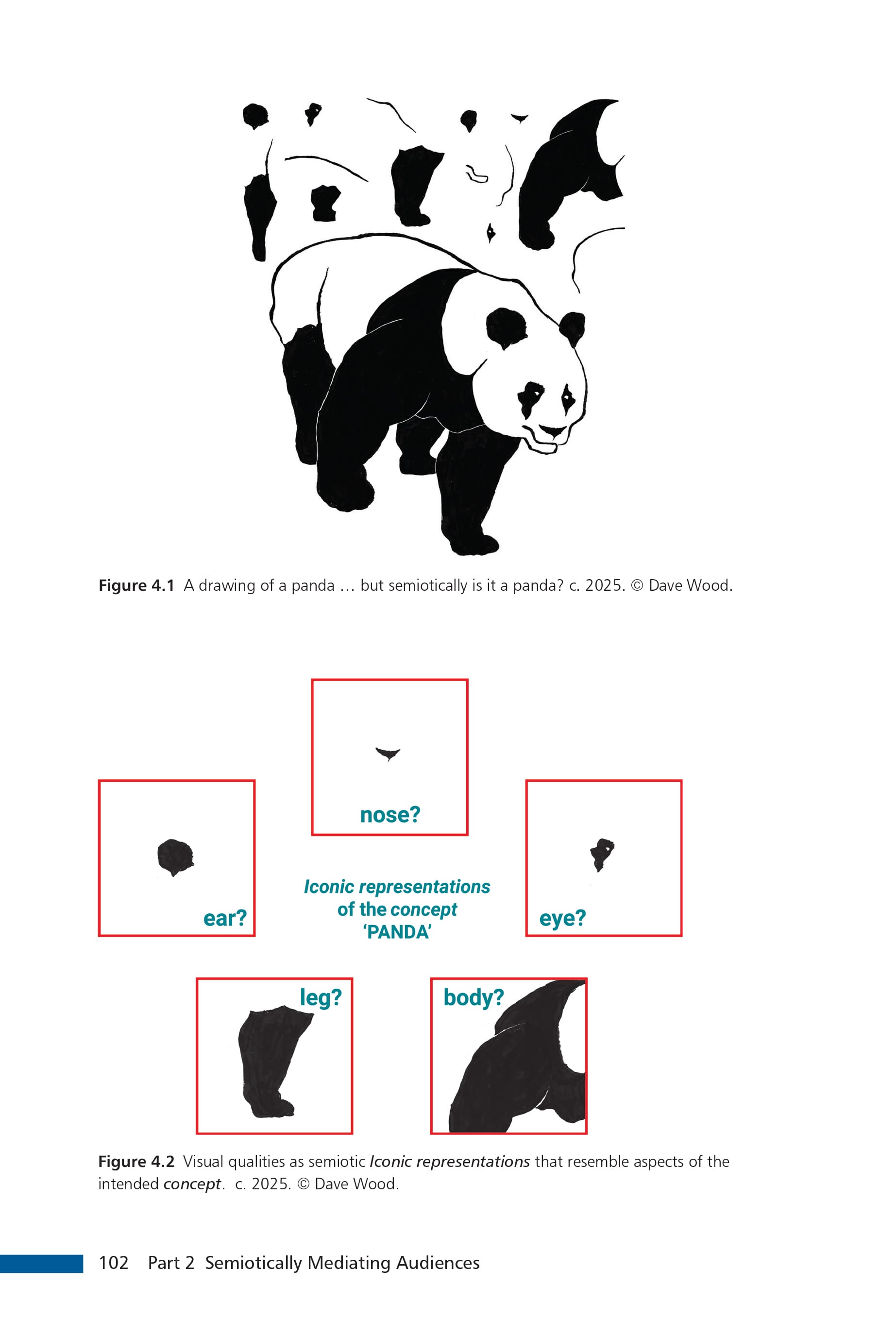
The panda drawing in this chapter is crucial in several important ways. Firstly, as a panda has distinctive markings the assumption is that pandas are well known as existent animals for a drawing to be ubiquitously interpreted as a panda.
Secondly, a panda can be visually represented by clever composition of its visual qualities. These first two points are a working Hypothesis on what my target audience has prior experience of. Peirce calls this form of logic Abductive reasoning, which has also been called the Logic of Design.
Thirdly, the panda drawing example allowed me to cycle through the pragmatic semiotic determination flow between the concept to be visually communicated, how that concept is visually represented, to then explain how the representation can be interpreted.
The panda drawing example is also useful to contextualise aspects of the three levels of pragmatic semiotic power - Perception Power, Communication Power and Delivery Power. I use two bespoke diagrams to segue into explaining Peirce’s ten classifications of semiotic signs based on those three semiotic power levels.
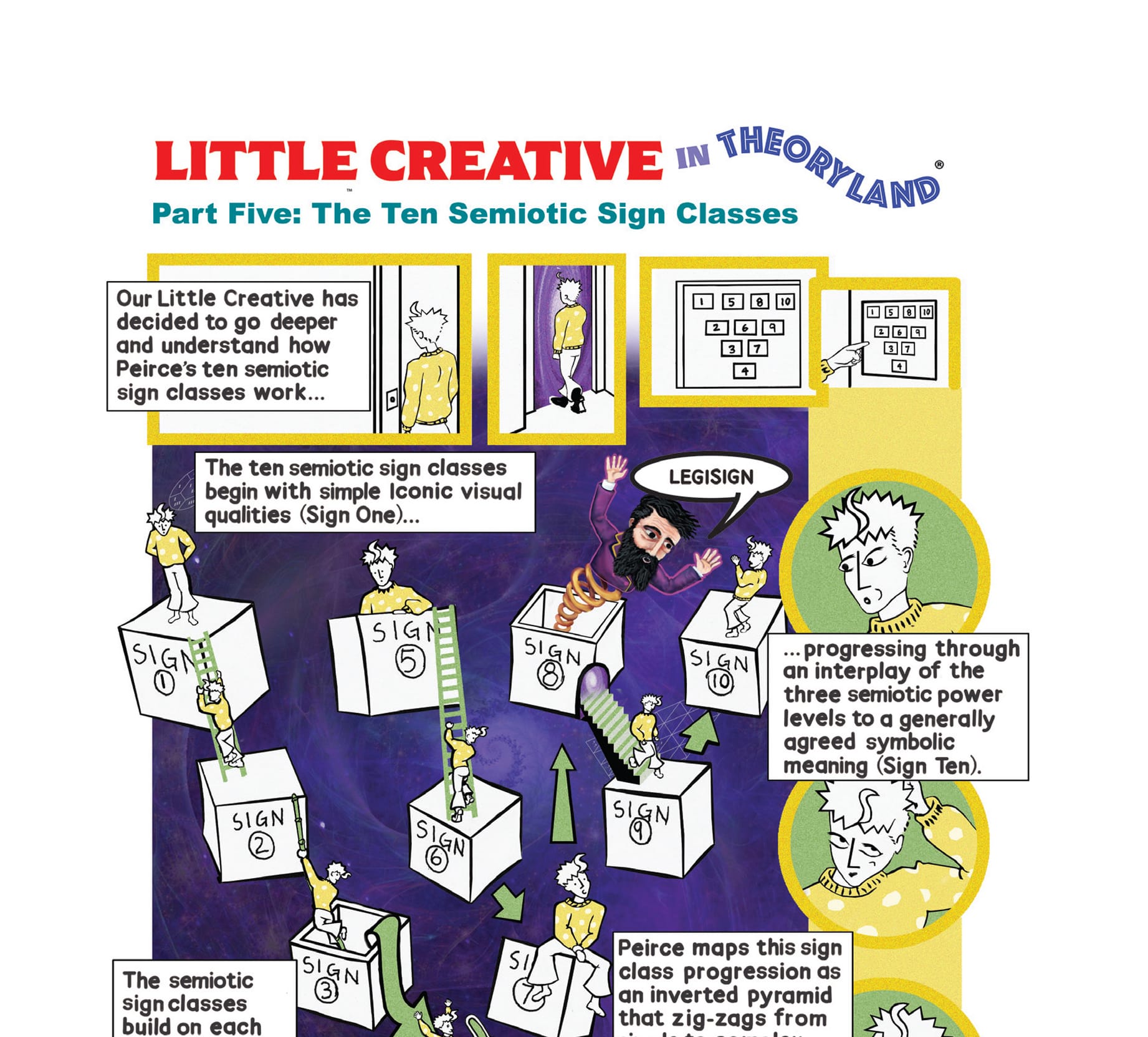
To help you designers and illustrators with this heavy dose of theory (written in plain creative-centric language) our Little Creative makes another excursion into Theoryland in their fifth comic strip infographic. By joining LC in a descending elevator (or a lift, if you culturally prefer), we witness how the ten pragmatic semiotic sign classes nest within each other to visually represent meaning.
Semiotically, these sign classes progress from simple qualities that are meaning-bearing (Sign Ones) right up to complex semiotic signs that are a proxy for a generally resolved and agreed socio-cultural meaning (Sign Tens).
Peirce, C.S. (1932) The Collected Papers of Charles Sanders Peirce. Vol. 2 Elements of Logic. Cambridge: Harvard University Press.
The Book
Semiotics for Designers and Illustrators is scheduled to be published in February 2027 by Bloomsbury Visual Arts. Check back to this newsletter for pre-ordering news and even discount codes …watch this space.
The Videos
Chapter four is also previewed in Semiosis 101’s season 5 episode 5.8 and expanded on in episode 5.9 on Patreon and YouTube.
These Semiosis 101 season 5 video episodes will be published on my @Semiosis101channel over the next few months on YouTube. Or you can watch the entire season 5 of twenty Semiosis 101 episodes months ahead of YouTube with a Semiosis 101 Patreon subscription.
With a Patreon subscription you’ll also get a Semiosis 101 Producer credit on all future YouTube editions (plus other exclusive Patreon-only video content).