014: Spotlight on Case Study One…
Semiotics for Designers and Illustrators book newsletter #14

In my Semiotics for Designers and Illustrators book (to be published by Bloomsbury Visual Arts in February 2027) I use nine case studies to help contextualise and expand your understanding of applying Semiosis. My first case study - Phenomenology in Creativity: a Human-centred Exploration of Semiotics - helps to explain the philosophy of phenomenology as it is central to understanding Charles Sanders Peirce’s semiotic theory and the application of Semiosis within illustration or design ideation.
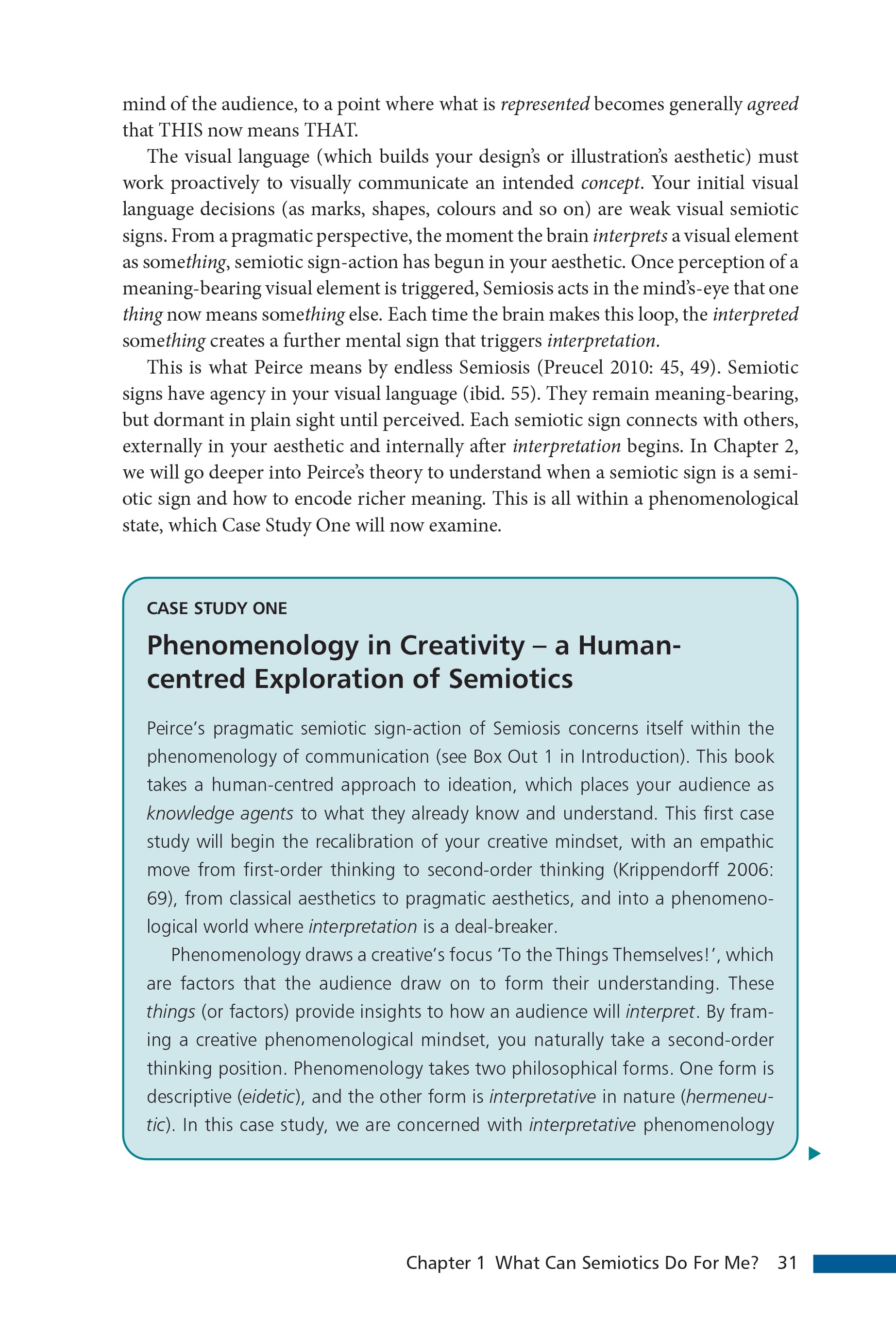
Phenomenology is essentially the study of phenomena, and the phenomena we are interested in are associated with visual communication, human perception and ability to interpret meaning from semiotic signs. We can frame this as the phenomenology of communication and I advocate treating your target audience not as passive consumers but knowledge agents. The form that this phenomenology takes is a hermeneutic or interpretive phenomenology.
My first case study advocates for you to adapt your creative mindset away from a closed loop between client > creative into a more open loop between client > creative > audience. At a micro level this interrelationship can be seen as Semiosis’ semiotic determination flow between concept > representation > interpretation.
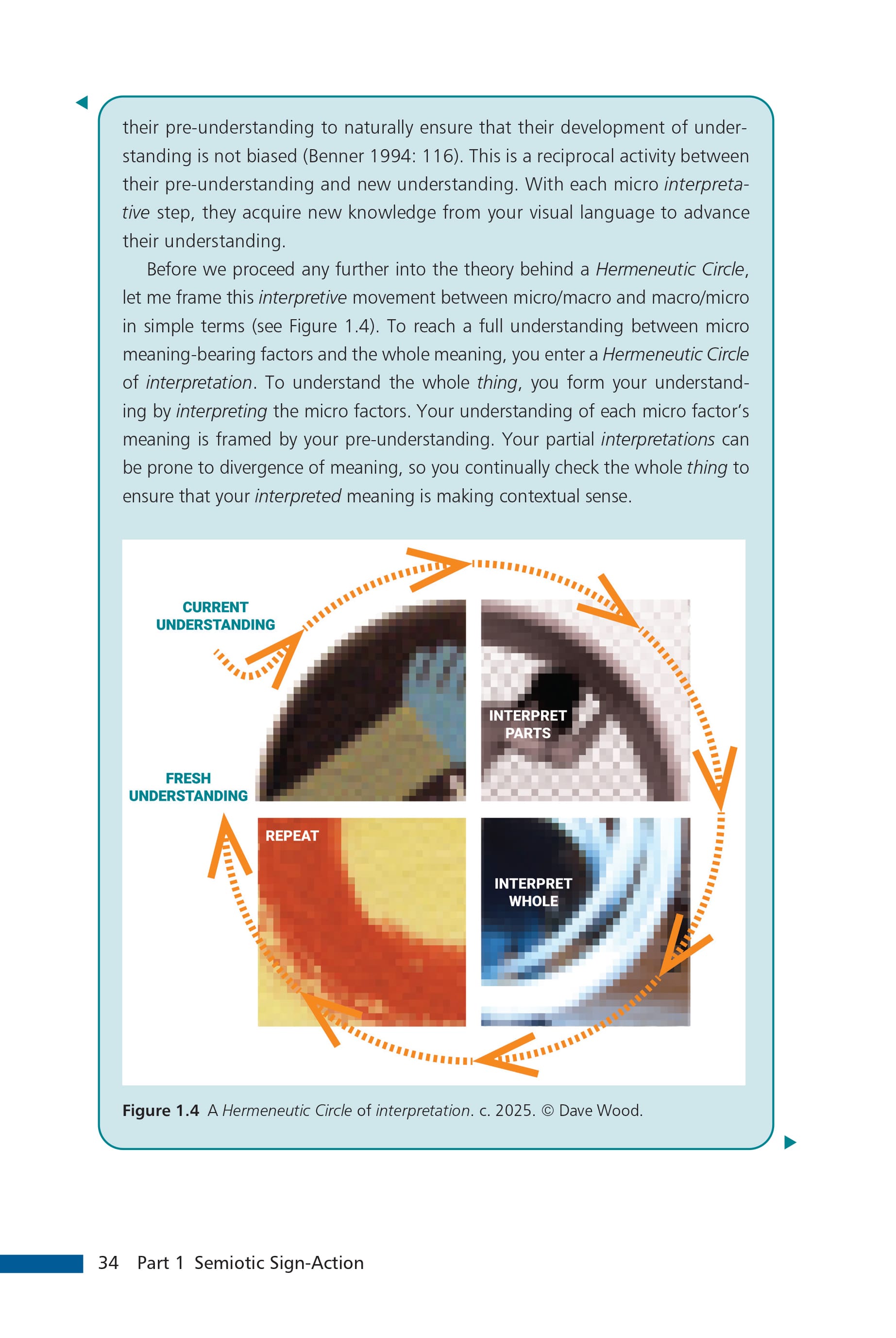
This macro/micro phenomenological framing of your creative practice is essentially a hermeneutic circle of interpretation. Phenomenology draws a creative’s focus ‘To the Things Themselves!’ These things are factors that your target audience draws on to form their understanding of what’s being visually communicated.
Phenomenology underpins Peirce’s pragmatic semiotic sign-action, within his phenomenological states of Firstness, Secondness and Thirdness. These states underpin the three semiotic power levels within a semiotic sign. Semiosis’ determination flow is triadic (threes), as semiotic signifiers and signified meaning is nothing without audience interpretation.
The final part of this first case study ends on one of my PhD experiments that informed my first synthesis of Peirce’s Semiosis with visual communication practice. The macro/micro approach to understanding any act of interpretation I mentioned earlier can be understood with a hermeneutic circle of interpretation phenomenological tool. The phrase “as above, so below” is an apt paraphrase to why a hermeneutic circle is relevant to a book on pragmatic semiotic sign-action.
Does a visual element exist only by its positive figure or by the negative-shaped background space? Or because of both? It is at this level of creative thinking that Semiosis gives you the theoretical scaffolding to shape your visual language to enrich deeper (intended) meaning. Later in the book I draw on Gestalt theory as another tool to apply Semiosis.
The Book
Semiotics for Designers and Illustrators is scheduled to be published in February 2027 by Bloomsbury Visual Arts. Check back to this newsletter for pre-ordering news and even discount codes …watch this space.
The Videos
Case study one is also previewed in Semiosis 101’s season 5 episode 5.4 on Patreon and YouTube.
These Semiosis 101 season 5 video episodes will be published on my @Semiosis101channel over the next few months on YouTube. Or you can watch the entire season 5 of twenty Semiosis 101 episodes months ahead of YouTube with a Semiosis 101 Patreon subscription.
With a Patreon subscription you’ll also get a Semiosis 101 Producer credit on all future YouTube editions (plus other exclusive Patreon-only video content).