022: Spotlight on Case Study Five
Semiotics for Designers and Illustrators book newsletter #22

In my Semiotics for Designers and Illustrators book’s fifth case study, I turn to a specific subject of Indonesian batik textile designs to explore encoding socio-cultural Symbolic meaning. In Indonesian Batik – Textiles with Culturally-encoded Symbolic Meaning I was pleased to feature the work of an Indonesian colleague’s own design research into her native textiles.
Indonesian batik has a long textile design history, and its many patterns are rich in socio-cultural Symbolic meaning to the communities who make it across the Indonesian archipelago. I was introduced to batik textiles while working in Jakarta, where I led an undergraduate design dual-degree at Binus Northumbria School of Design campus. While working at Binus I was introduced to the batik research of one of Binus’ graphic design lecturers. Dr Vera Jenny (Jane) Basiroen.
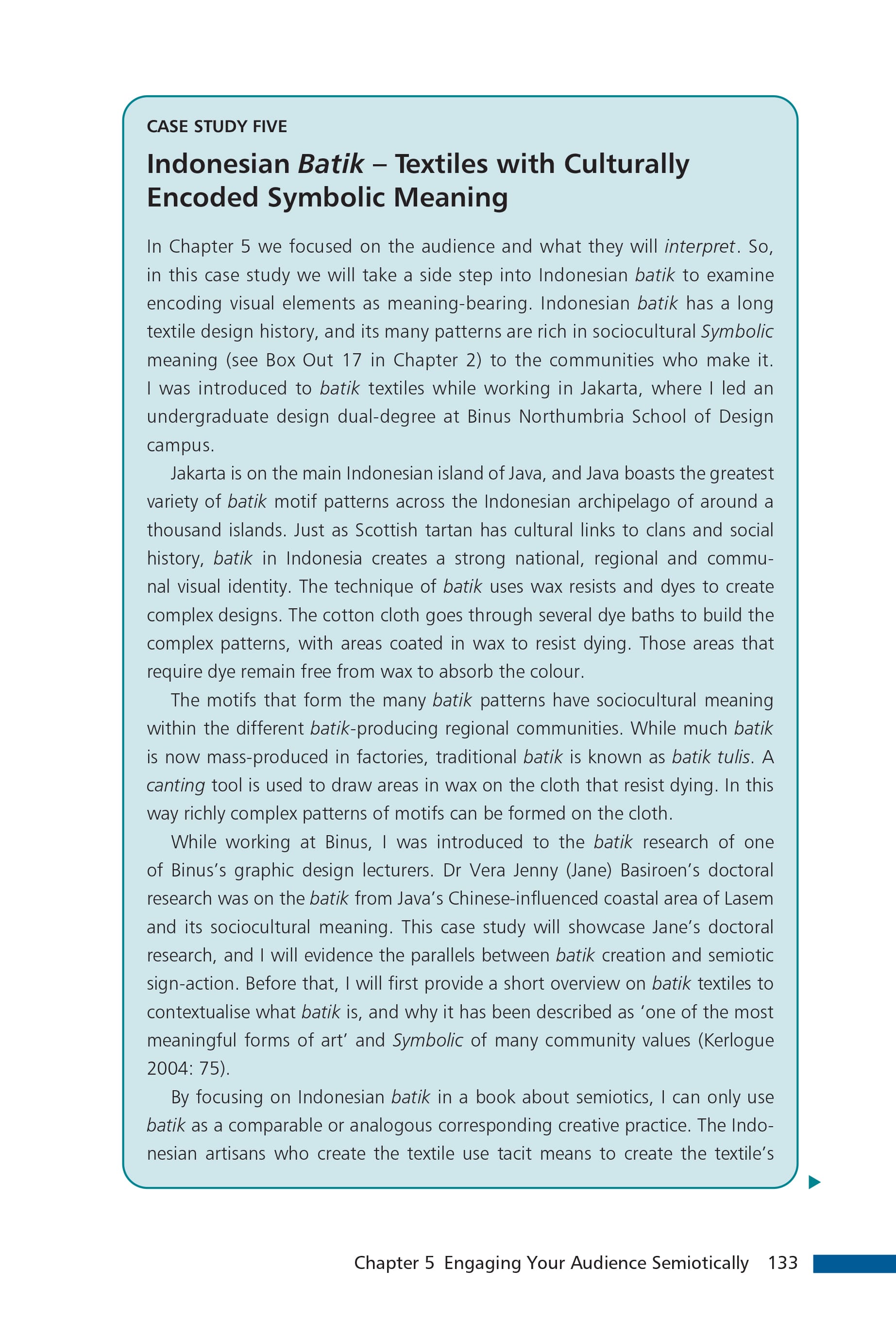
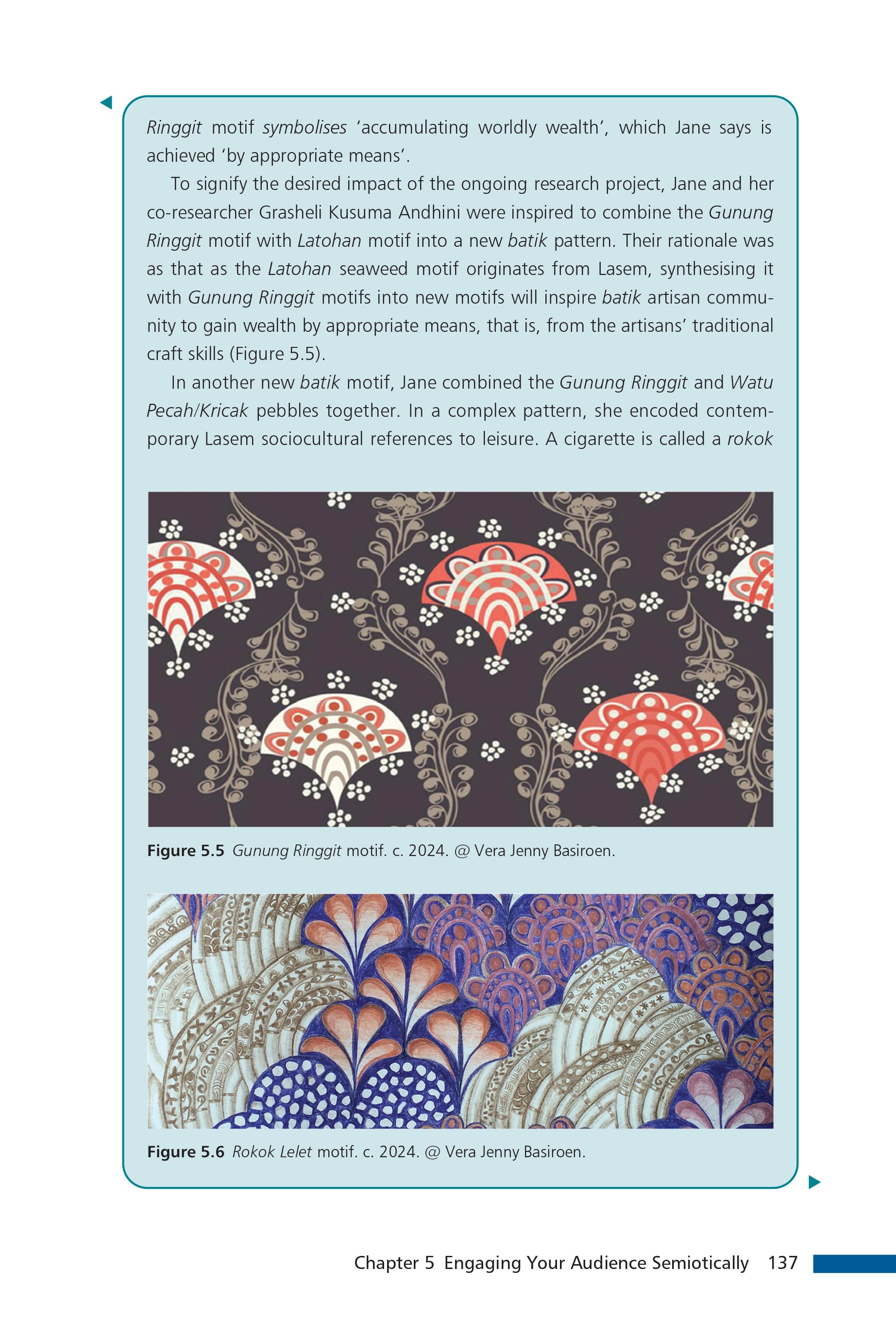
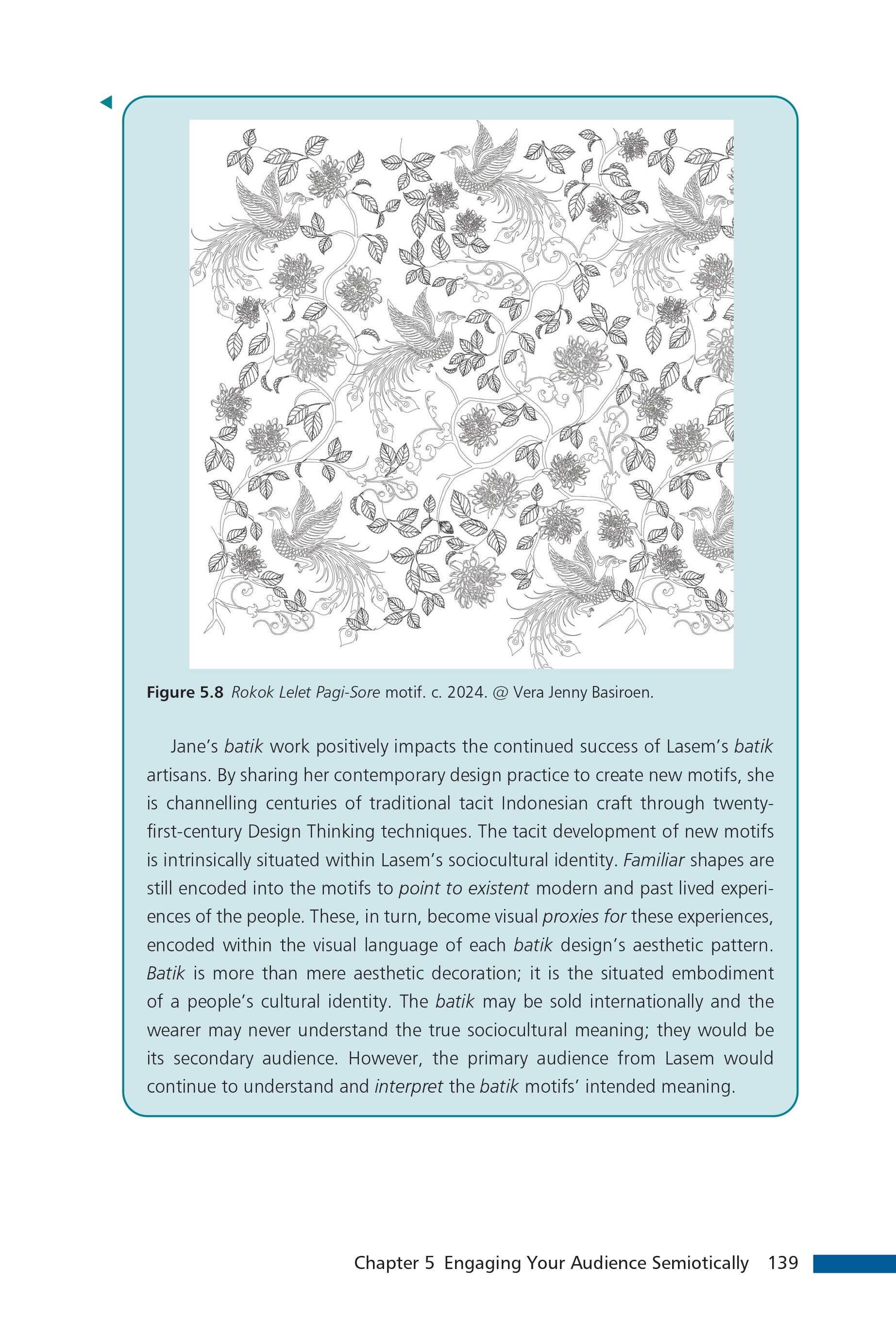
Selected pages from case study five on Indonesian batik and cultural Symbols.
Indonesia’s capital Jakarta is on the main island of Java. Jane’s doctoral research was on the batik from Java’s Chinese-influenced coastal area of Lasem and its socio-cultural meaning. Case study five showcases her doctoral research, which I then use to draw parallels between batik creation and pragmatic semiotic sign-action.
For those of you who are not familiar with batik, the technique of creating batik textiles uses wax resists and dyes to create complex designs. Cotton cloth goes through several dye baths to build complex patterns, with areas coated in wax to resist dying. Those areas that require dye remain free from wax to absorb the colour. Just as Scottish tartan has cultural links to clans and social history, batik in Indonesia creates a strong national, regional and communal visual identity.
Java can boast the greatest variety of batik motif patterns across Indonesia’s thousand islands. The motifs that form the many batik patterns have socio-cultural meaning within the different batik-producing regional communities.
While much batik is now mass-produced in factories, traditional batik is known as batik tulis. A canting tool its used to draw areas in wax on the cloth which resists dying. In this way richly complex patterns of motifs can be formed on the cloth.
Jane’s batik research work is positively impacting on the continued success of Lasem’s batik artisans. By sharing her contemporary design practice to create new motifs, she is channelling centuries of traditional tacit Indonesian craft through 21st century Design Thinking techniques. The tacit development of new motifs is intrinsically situated with Lasem’s socio-cultural identity. Therefore, it segues nicely into explaining an application of pragmatic Symbolic semiotic visual communication.
The Book
Semiotics for Designers and Illustrators is scheduled to be published in February 2027 by Bloomsbury Visual Arts. Check back to this newsletter for pre-ordering news and even discount codes …watch this space.
The Videos
Case study five is also previewed as an exclusive Semiosis 101 Patreon extended video. This special Semiosis 101 episode features Jane talking about her batik research as we discuss this case study.
These Semiosis 101 season 5 video episodes will be published on my @Semiosis101channel over the next few months on YouTube. Or you can watch the entire season 5 of twenty Semiosis 101 episodes months ahead of YouTube with a Semiosis 101 Patreon subscription.
With a Patreon subscription you’ll also get a Semiosis 101 Producer credit on all future YouTube editions (plus other exclusive Patreon-only video content).