021: Spotlight on Chapter Five
Semiotics for Designers and Illustrators book newsletter #21
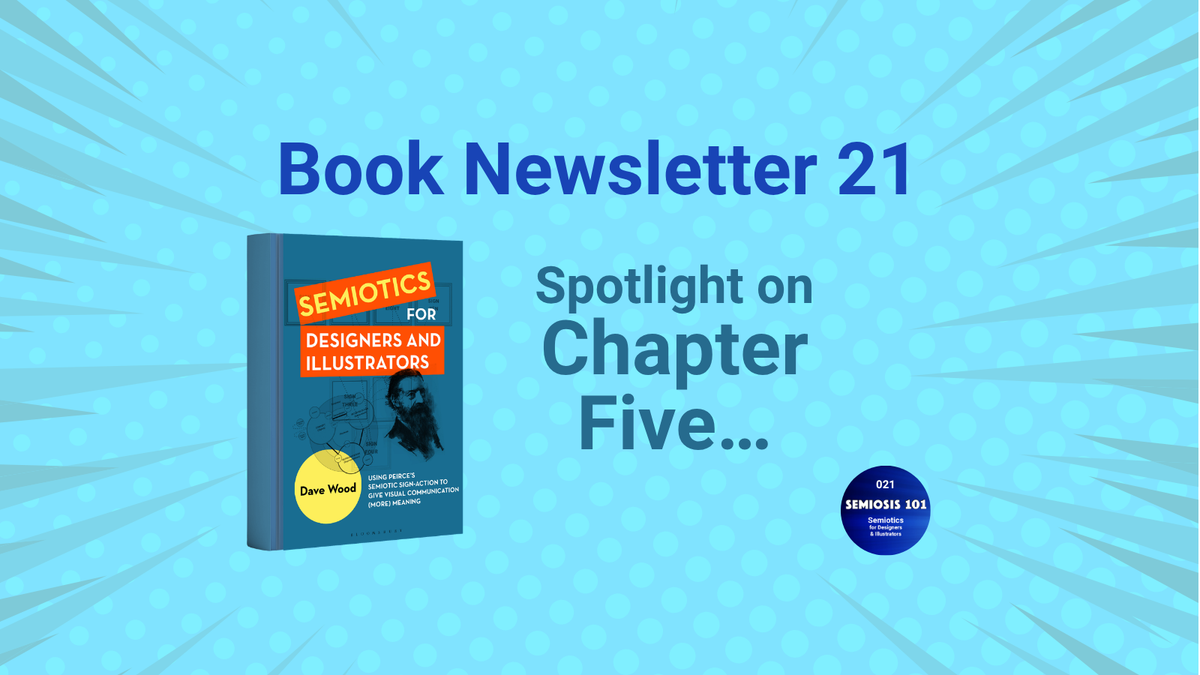
In this week’s book newsletter I put the spotlight on chapter five. Its title is Engaging Your Audience Semiotically and is midpoint in Semiotics for Designers and Illustrators’ nine chapters and midway within part two of the book, which covers semiotically mediating your target audience.
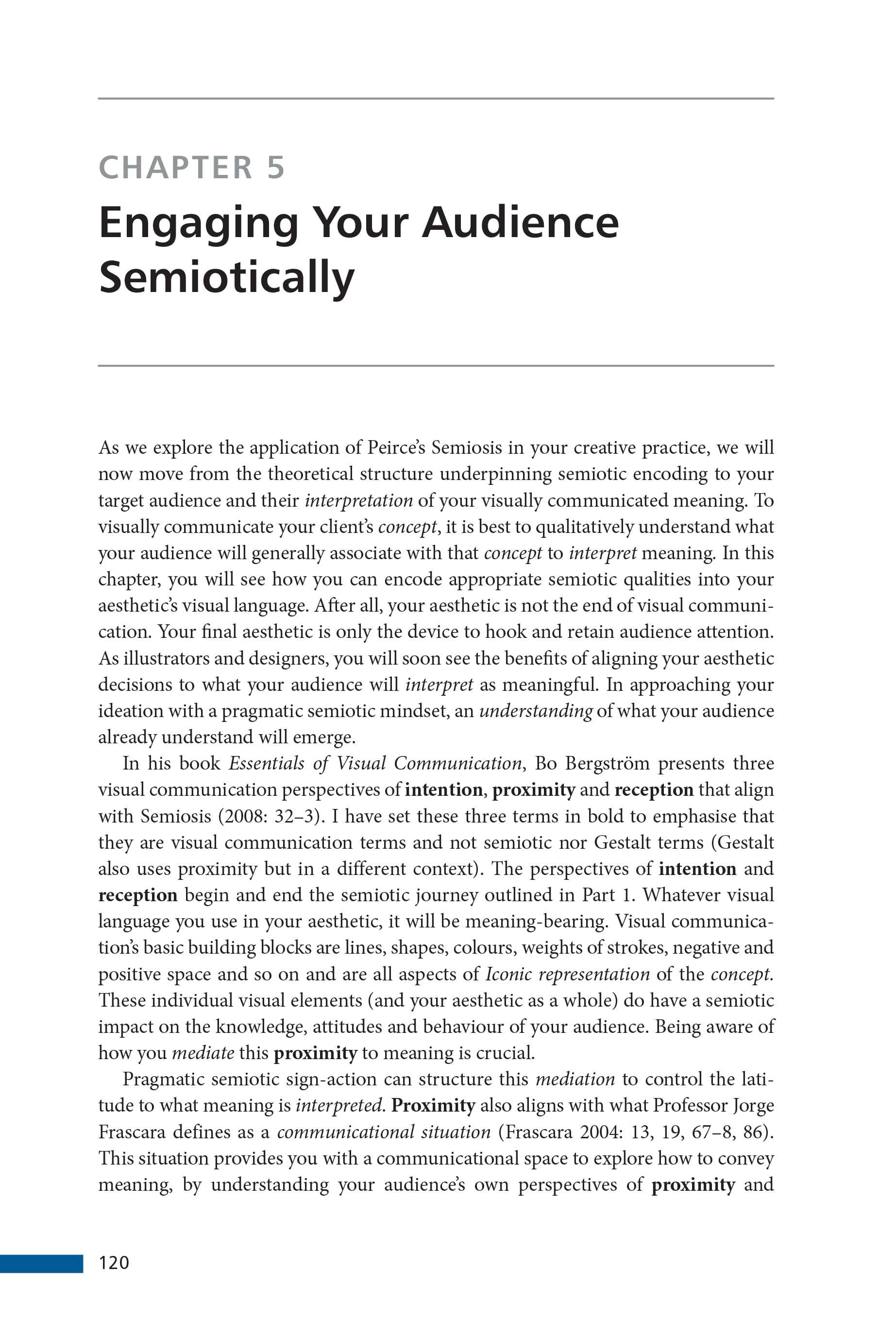
At this point of the book the focus turns from explaining semiotic theory to practical application of Charles Sanders Peirce’s Semiosis into creative practice. Part one of my book introduced the reader to your target audience’s lifeworlds. This is a phenomenological term which encompasses the audience’s socio-cultural lived experiences and prior reference points that they rely on to interpret meaning. These earlier chapters also introduced you to the Logic of Design - Peirce’s Abductive reasoning to research and develop a working Hypothesis of what these prior reference points could be.
This chapter helps you to navigate the semiotic theory, in the context of your own design or illustration practice, to use these lifeworlds to ‘hack’ directly into your target audience’s perception as you develop your visual language. This semiotic ‘hacking’ is achieved through the cultural clues you gain from understanding your target audience’s prior experiences, and then use that insight to cue your visual aesthetic to make semiotic connections with the audience.

To aid your semiotically-enriched ideation, I introduce a semiotic spin on the designer’s user persona tool I first outlined in chapter three. The semiotic audience persona is a new tool that utilises Max van Manen’s four existential lenses of Lived Time, Lived Body, Lived Space and Lived Human Relationships to form a visualised working Hypothesis of your target audiences socio-cultural clues and cues.
The delivery of semiotic meaning to an engaged audience does not happen all at once. Their perception of your representation of meaning grows the longer they remain engaged with your illustration or design. This is why your aesthetic decisions and visual language needs to connect with your target audience’s prior reference points. A semiotic audience persona aids you to consider what visual language qualities will make subconscious connections with your audience.
These initial visual qualities are essentially the first step in using visual semiotic signs. Peirce calls these Qualisigns, which are intended to grab attention with the possibility of each visual quality bearing weak meaning. Once subconscious perception of possible meaning is triggered, then your aesthetic can begin the helical process of Semiosis to suggest and resolve when the audience sees THIS (the representation) it’s semiotically a proxy for THAT other thing (the interpretation of the intended concept)!
The Book
Semiotics for Designers and Illustrators is scheduled to be published in February 2027 by Bloomsbury Visual Arts. Check back to this newsletter for pre-ordering news and even discount codes …watch this space.
The Videos
Chapter five is also previewed in Semiosis 101’s season 5 episode 5.11 and the semiotic audience persona is expanded on in episode 5.12 on Patreon and YouTube.
These Semiosis 101 season 5 video episodes will be published on my @Semiosis101channel over the next few months on YouTube. Or you can watch the entire season 5 of twenty Semiosis 101 episodes months ahead of YouTube with a Semiosis 101 Patreon subscription.
With a Patreon subscription you’ll also get a Semiosis 101 Producer credit on all future YouTube editions (plus other exclusive Patreon-only video content).