017: Spotlight on Chapter Three
Semiotics for Designers and Illustrators book newsletter #17

In my Semiotics for Designers and Illustrators book (February 2027), its chapter three concludes the first of thematic three parts, the first of which explains Semiotic Sign-action. Chapter three’s title is Semiotically Communicating Anything to Anyone and it semiotically focuses on three crucial subjects for illustrators and designers: your ideation phase, your target audience’s lived experiences and your aesthetic decisions.
Chapter three explains ideation in six phases, from the client’s brief to design or illustration outcomes. It then maps these six phases to Semiosis’ Perception, Communication and Delivery Power levels. In doing so, this chapter places you into a phenomenological position to appreciate how your existing creative process needs to appreciate your target audience’s lived experiences (their lifeworlds). It is within this relationship between creative ideation and the audience’s prior reference points that semiotic mediation happens.
As part of this theoretical discussion, chapter three also introduces the phenomenological idea of the ideating creative ‘wearing an experience’ to help them get into the mind of the target audience. This entails Abductive reasoning to form a working Hypothesis of what their prior experiences are and generate audience personas to summarise these useful insights.
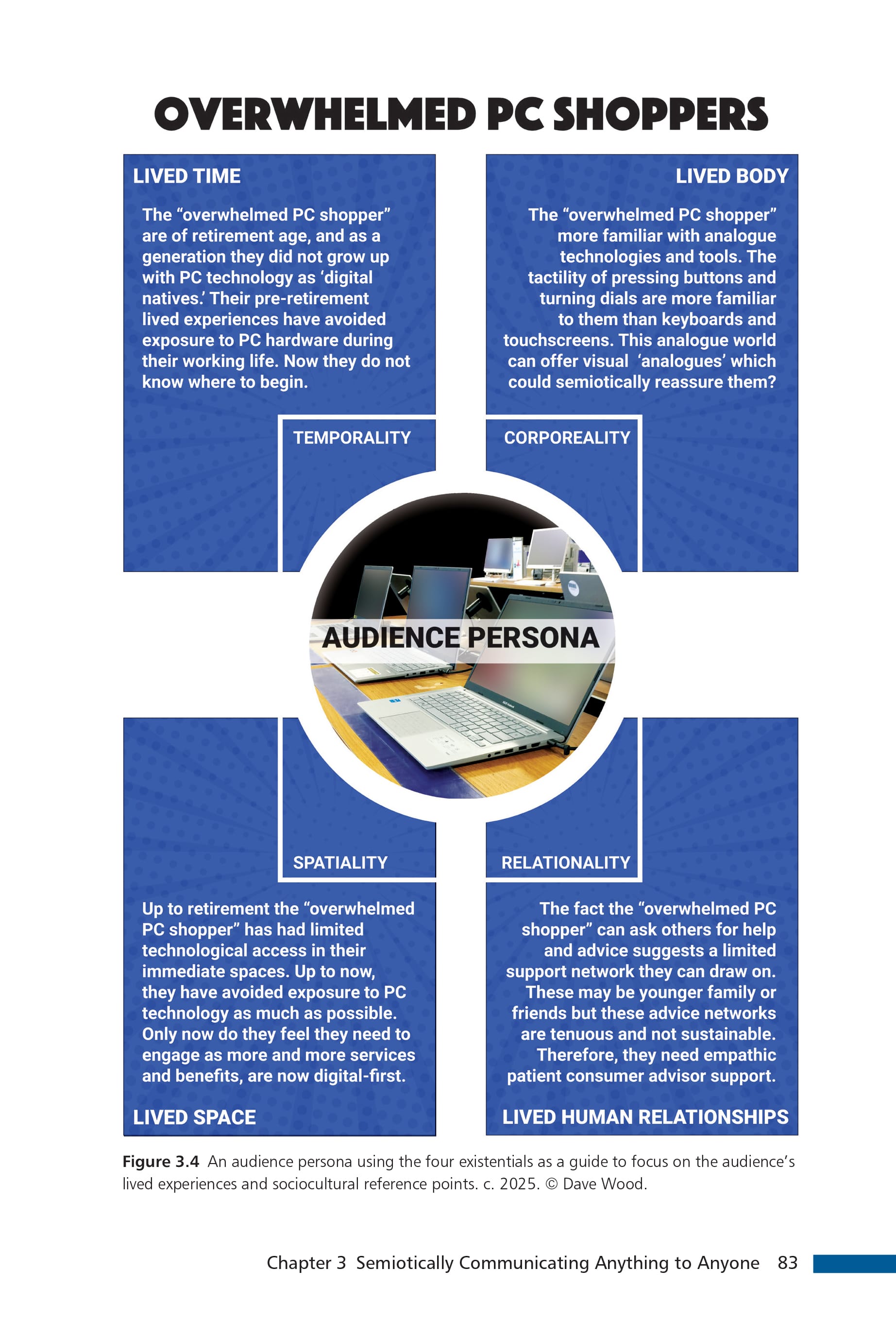
‘Wearing an experience’ helps designers and illustrators to develop an appropriate meaning-bearing visual language to semiotically mediate the meaning they intend. This is semiotically controlling the audience’s latitude for interpreting meaning. To ‘wear an experience’ as you ideate, chapter three folds in another theoretician to augment Peirce. Max van Manen’s work on lived experience provides us with four existential lenses through which experiential contexts can be understood: lived body, lived time, lived space and lived human relationships.1
Van Manen’s four existentials provide you with the structure to build semiotic audience personas. Using Abductive reasoning (the Logic of Design) to form these working Hypotheses of your audience’s lifeworlds.
Finally, I focus on your aesthetic, but not as ‘passive beauty.’ Instead your aesthetic is pragmatically proactive. Interpretation is not passive; it is an active state of perceiving meaning to understand what is meant. Peirce explains that the semiotic representation of the intended concept has an effect on the minds of the audience which can be semiotically mediated to control the latitude for interpretation.
Chapter three’s title boasted about semiotically communicating anything to anyone, and it didn’t over-promise. Your client’s brief could be anything, and their audience could be anyone, and this chapter provides some important new pragmatic semiotic strategies and tools.
The Book
Semiotics for Designers and Illustrators is scheduled to be published in February 2027 by Bloomsbury Visual Arts. Check back to this newsletter for pre-ordering news and even discount codes …watch this space.
The Videos
Chapter three is also previewed in Semiosis 101’s season 5 episode 5.5 on Patreon and YouTube, and ’wear an experience’ is expanded on in episode 5.6 and then later in 5.12.
These Semiosis 101 season 5 video episodes will be published on my @Semiosis101channel over the next few months on YouTube. Or you can watch the entire season 5 of twenty Semiosis 101 episodes months ahead of YouTube with a Semiosis 101 Patreon subscription.
With a Patreon subscription you’ll also get a Semiosis 101 Producer credit on all future YouTube editions (plus other exclusive Patreon-only video content).