Free Semiosis 101 Transcript 4.19:
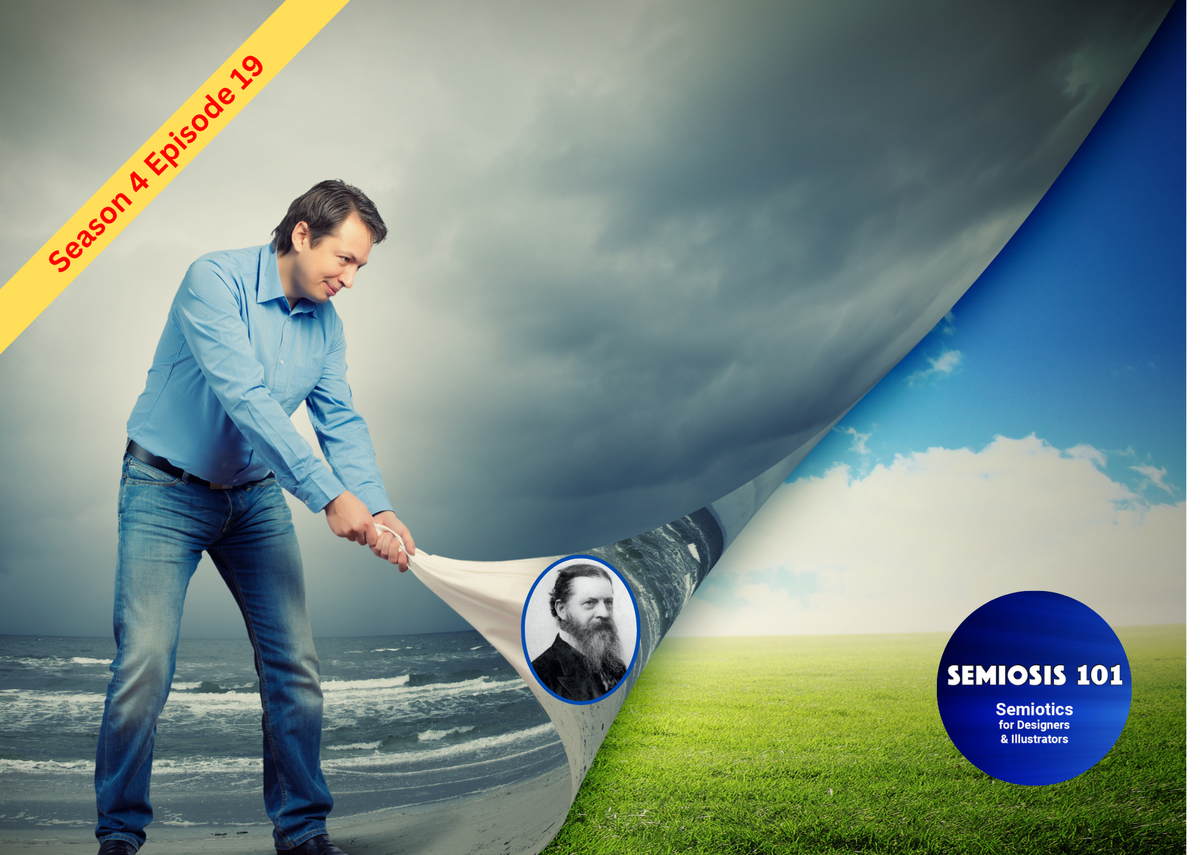
How can Semiosis CHANGE a Creative’s Mindset?
Hello readers.
In this free transcript for the episode 4.19 published on Semiosis 101 on Weds 21st January 2026, we move from enhancing the visual communication of the messages, to how you (the creative) can now approach ideation in a semiotic way with Semiosis.
A visual semiotic sign is always in plain sight. A semiotic sign in your aesthetic remains dormant until it is perceived by your audience as meaning-bearing. If you think a semiotic sign is a tangible thing like signage then your semiotic mindset needs re-calibrating. T
he big revelation this season has been you have ALWAYS been working semiotically …you just have not realised it until now…
Watch the free episode on YouTube for the full impact…
…and here is the episode’s transcript.
How can Semiosis CHANGE a Creative’s Mindset?
This season’s theme is developing a fresh semiotic mindset to your creative work. For newbies, this is about applying Peirce’s semiotic theory of Semiosis to what you illustrators and designers already do well. Our focus has been on small simple changes in enhancing the effectiveness of your visual communication to an audience. Let us see how Semiosis can help you…
A visual semiotic sign is always in plain sight. A semiotic sign in your aesthetic remains dormant until it is perceived by your audience as meaning-bearing. If you think a semiotic sign is a tangible thing like signage then your semiotic mindset needs re-calibrating.
The big revelation this season has been you have ALWAYS been working semiotically …you just have not realised it until now. In this 19th (and penultimate) episode of Semiosis 101’s season four, we move from enhancing the visual communication of the messages, to how you (the creative) can now approach ideation in a semiotic way with Semiosis.
Season four has inspired you to do three things, and all of these things are about facilitating your own creative mindset, to facilitate audience behavioural changes to interpret the intended meaning.
Three simple words. Realise. Embrace. Apply.
First, REALISE where you have already been working semiotically. Realisation opens up new patterns of how you ideate and craft your designs and illustrations.
Second, EMBRACE second-order thinking to work more empathically as you sketch ideas to answer the client’s brief. By embracing a more human-centred (rather than a creative-centred) approach to how you develop your visual language, you can gain valuable insights into how your target audience’s lifeworlds influences how they make interpretations.
Third, APPLY the principles of Semiosis to help you to enhance how you effectively visually communicate, by switching to semiotically structuring your visual language. By applying the principle’s of Peirce’s Semiosis into your new human-centred approach to ideation, you have the semiotic structure to control how meaning-bearing visual elements will be interpreted as intended.
Realise. Embrace. Apply. Sounds simple put like that, yes? But let us see how you can now apply this new semiotic mindset in practice. Have you noticed I am principally discussing what happens during your ideation phase? Your development of ideas stage. The sketching of possible ways to answer the problem set by your client in their brief. Without ideation the design or illustration would be superficial. So I am not discussing superficiality.
On Semiosis 101 I am discussing the semiotic structuring of visual communication. From your basic visual communication building blocks of lines, marks, strokes, shapes, colours, etc. up to the your completed design or illustration. These basic building blocks, even in its simplest forms, have the potential for meaning-bearing. Therefore, through Semiosis, your creative process can be strengthened to reduce any mis-communication.
Semiosis - pragmatic semiotic sign-action - includes a perceptual flow between the concept your client needs you to mediate to their target audience. How you mediate this, whether as a design or an illustration outcome, is through semiotically enhancing what you creatives already do. In your designs and illustrations, you create aesthetic outcomes which visually communicate the messages the client desires. To create these you use many techniques, styles and media.
Great. That is what you already do. How Peirce’s Semiosis benefits this established creative process is that he brings the audience into the client’s concept and creative’s representation working bubble. Peirce’s pragmatic semiotic theory differs from Saussure/Barthes’ Semiology of Signifier | Signifier. Semiosis’ flow is between concept > representation > interpretation. The interpretation by the audience is crucial to your successful visual communication of meaning to them.
The benefits of applying Semiosis principles to your ideation, brings the audience into how you develop you visual language. Remember we are talking connotative meaning here, and not denotative “This IS this” meaning. Over the last four seasons of Semiosis 101 I have put the principles of Semiosis into designer-centric terms. Peirce’s theoretical writing is really quite obtuse to the lay-reader. I can only summarise these principles in the next five minutes, so buckle up.
You may be more comfortable with the term ‘tone of voice.’ That ephemeral phrase that covers lots of things a creative needs to EVOKE through your visual language decisions. Semiosis is your semiotic ally in visually evoking the right visual mood, tone, emotion in what you design or illustrate. Have you noticed I have yet to mention semiotic signs? I have not had to mention semiotic signs by name, as they have already been there in plain sight. Remember a semiotic sign is not signage. The semiotic determination flow I mentioned earlier is… concept > representation > interpretation. This is the meta client|creative|audience model.
You creatives are involved in the semiotic representation of the client’s concept. Your audience is involved in perceiving, understanding and interpreting what is meant, to then take action. What you aesthetically produce to answer the client’s brief has an active life with the audience. It is their perception that triggers the mediation of meaning. After all Peirce states that a semiotic sign’s power is dormant UNTIL perceived as meaning-bearing. This subconscious instant move from no perception of possible meaning to meaning-bearing is because of your audience perceiving visual familiarities.
Peirce’s semiotic sign-action power is threefold. Each semiotic sign is powered through levels of Perception, Communication and Delivery, from simple to complex…
Perception Power (Sign Intensity)
possible >
suggested >
resolved.
Communication Power (Concept Communication)
familiar >
existent >
proxy.
Delivery Power (Effect on Interpreter)
instant >
mediated >
agreed.
The weakest type of semiotic sign is a visual quality. Yes a simple stroke or colour can be all it takes to instantly trigger your audience to perceive possible deeper meaning. What they have perceived represented has a familiar quality to something they have experience of. If you want to read more about this go to the Semiosis 101 Semiotic Resource on semiosis101.online. Link is in the description.
If a simple quality can trigger the audience to begin interpreting the visual language for deeper meaning, then the sign-action has begun. Your visual language’s basic building blocks can be aligned to mediate from familiar qualities to lead the audience to interpret existent things from what is represented. These then can be used to craft more sophisticated aesthetics that semiotically lead the audience from possible meaning, to suggested meaning.
From the instant moment of perceiving weak meaning, the semiotic signs begin to mediate the audience to the deeper embedded meanings. As I have constantly stated semiotic signs are not tangible, they are encoded from the marks and shape qualities. How a simple semiotic quality can contribute to a deeper and more complex meaning lies in the nesting of signs with signs.
Do not overthink think this. You already have the skills to do this.
A single stroke of a brush does not make a completed picture! Any complex finished design or illustration comprises of many smaller visual elements, all working together to complete the bigger picture. Semiotic signs map to each stage.
Did I not state you have always been working semiotically?
Now with a fresh semiotic mindset approach to your ideation, you hopefully now REALISE Semiosis is a natural extension to what you already do. If you have reached that realisation, then EMBRACE all that Semiosis can do to now help you APPLY it into your existing creative process, to structure how you visually communicate. These three steps help you to begin to adapt your existing creative process, during ideation, to strengthen what you visualise to connect with your audience’s lived experiences.
In a recent episode I called the audience your knowledge agents. Their lived experiences are very insightful. You may need to go back and watch four seasons’ worth of Semiosis 101 episodes to understand how to APPLY Semiosis. That is fine, the episodes are all freely available archived on YouTube. Future season five episodes will now go into more depth. These episodes are currently available to watch on Semiosis 101’s Patreon, before they eventually get published on YouTube.
Remember Semiosis 101 is not a semiotics course, but a designer-centric explanation of Peirce’s pragmatic semiotic theory. Subscribe to to be notified when the final season four episode is published. It will review what you will have learnt this season to develop your own fresh semiotic mindset. Or become a Semiosis 101 Producer on Patreon and watch all future episodes months ahead of YouTube …plus other Patreon-only exclusive video content.
Hint… hint…
Semiosis 101 Semiotic Design Resources is a reader-supported publication. To receive exclusive posts and support my work, consider becoming a free or paid subscriber. Paid subscribers get name checked on all future Semiosis 101 YouTube episodes.
===Semiosis 101 Patreon Producer==============
Become a Semiosis 101 Patreon Producer and get a named producer credit on future video episodes, plus watch all new episodes months ahead of YouTube.
===Semiosis 101 Patreon Exclusives==============
Watch longer Patreon-exclusive Semiosis 101 episodes on applying Semiosis into design and illustration…
PATEXC001 How does semiotics work in illustration?
 Semiosis 101