Free Semiosis 101 Transcript 4.14:
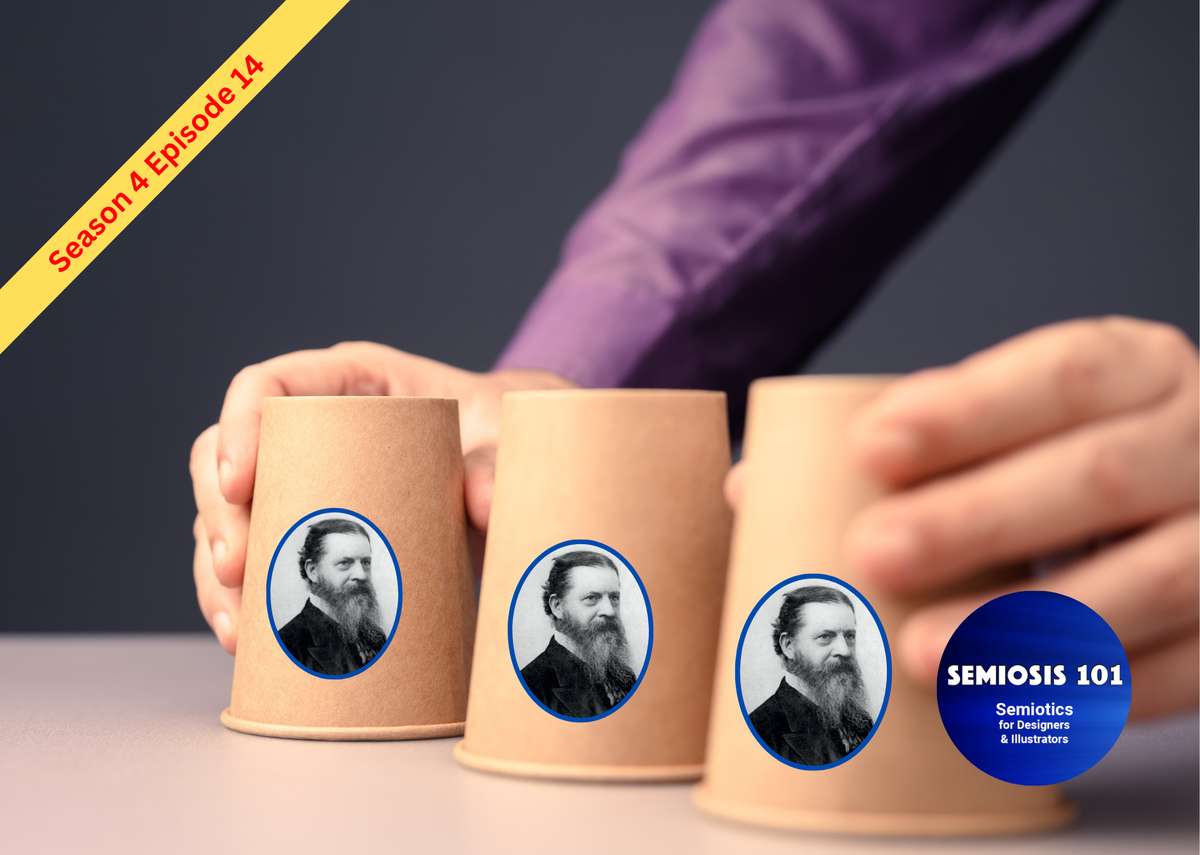
How Can CREATIVES AVOID Second-guessing What Audiences Understand?
Hello readers.
In this free transcript for the episode 4.14 published on Semiosis 101 on Weds 29th October 2025, we move from tacit knowledge to informed semiotic practice, and from first-order thinking to second-order thinking. A semantic turn if you prefer, but another step in developing your semiotic mindset.
Applying Semiosis in your ideation phases provides you with the visual communicational structural know-how to ensure your visual language is meaning-bearing. To help you to semiotically hook and retain your audience’s attention, let us treat your target audience as knowledge agents…
Watch the free episode on YouTube for the full impact…
…and here is the episode’s transcript.
How Can CREATIVES AVOID Second-guessing What Audiences Understand?
By using a working Hypothesis about your audience at the beginning of your ideation phase, you have a fluid, scalable research strategy starting from known “truths.” With second-order thinking, the more we learn more about what our audience has experience of and understands, you are no longer “second-guessing” how to encode semiotic meaning into your visual language. Let us see how this works…
As creatives, we describe what we create as coming from tacit knowledge. We “instinctively know” how we will answer the creative problem our clients set us. Our skilled practice is a knowledge we “cannot tell.” In this 14th episode of Semiosis 101’s season four, we move from tacit knowledge to informed semiotic practice, and from first-order thinking to second-order thinking. A semantic turn if you prefer, but another step in developing your semiotic mindset.
So far in recent episodes we have explored aligning your ideation phase with your audience’s lived experiences. Applying Semiosis in your ideation phases provides you with the visual communicational structural know-how to ensure your visual language is meaning-bearing. To help you to semiotically hook and retain your audience’s attention, let us treat your target audience as knowledge agents.
The audience’s lived experiences provide you creatives with clues to what qualities they already are familiar with. These familiar qualities can be hacked in ideation to visually communicate the intended concept to your audience. By framing your audience from passive consumers to knowledge agents you will be centring them within your ideation. This small change in your mindset will position yourself within a human-centred creative process.
From this human-centred position, your application of pragmatic semiotic sign-action moves you from first-order thinking to ideating more empathically. Peirce’s pragmatic approach provides you with a logical way to understand your audience’s contextual understanding, by using a working Hypothesis. This is how he describes Abductive reasoning, which has also been referred to as the “logic of design.”
I argue that Peirce’s Abductive reasoning (hypothesis) aligns with second-order thinking. I have already spent time in seasons 2 and 3 covering Hypothesis, so check out those playlists. Second-order thinking is something that Klaus Krippendorff discusses at length within human-centred design. Krippendorff is not complimentary about the power of semiotics, but I think he mistakes Peircean semiotics for how Sausserian Semiology approaches meaning.
Your act of forming a working Hypothesis, of how your target audience already experiences things-in-the-world, forces you to build your understanding of what they understand. This is why I reframe the audience as knowledge agents. Audience’s lived experiences of what they are already familiar with, will be revealed in terms that the audience already use. Their contextual frameworks are constructed from how they socio-culturally understand what they experience. This experiential context is sensed and learnt, and offers you culturally established visual touch-points.
Now, at this moment you may be thinking many opposing points of view, based on how you have been taught at design school. I understand that. I encounter it every time I talk with colleagues and professionals. So, before we proceed, to help you re-calibrate your creative mindset, I want to remind you of two important points. Firstly, I am framing your design or illustration ideation phase through a pragmatic philosophical lens of Charles Sanders Peirce’s theory of semiotic sign-action - Semiosis. Secondly, I am drawing your attention to the “ACTION” part of his semiotic sign-action. This “ACTION” is not the action of the creative. Rather it is the “ACTION” of the visual language used as an effect in the mind of your target audience. Creatives and their audience are engaged in a communicational situation.
Now that I have re-emphasised these two points, let us consider this communicational situation and how Semiosis is beneficial to enhancing how you visually communicate. Whatever you creatives create has latent meaning-bearing qualities even if you do not intend or realise it. Why? Humans are hard-wired to interpret meaning from what they see. Remember Peirce states that nothing is a semiotic sign UNTIL it is PERCEIVED as something more than the obvious denotation. Until what is seen is interpreted as sign for something else. This interpretation is contextual, and socio-culturally informed by what the audience has understood from within the context of their lived experience - their lifeworlds.
It is within these socio-cultural contexts that your audience researches can discover insights that will visually resonate with your audience. These insights are your semiotic Trojan Horse. Any contextual insights that your audience research provides you, no matter how immediately superficial, helps you form a working Hypothesis. You do not immediately need huge amounts of professional obtained marketing data. In fact you may not have the budget or time to even contemplate that level of audience research. That is why the logic of Abductive reasoning is referred to as the “logic of design.”
Peirce refers to Abductive reasoning as Hypothesis, and Hypothesis’ “truth” is not fixed. It evolves with each additional piece of fresh context you reveal about your audience. Hypothesis is a qualitative tool to empathically understand, and confirm, how your audience’s contextual experience will inform their interpretation of what they see. Hypothesis helps you to begin ideating from scraps of knowledge. Applying Semiosis helps you align your visual language.
By employing second-order thinking… by treating your target audience as knowledge agents, and… by re-calibrating your creative mindset, to understand that what you create will also have a subconscious effect on the minds of your audience…
…your ideation can be informed by key qualitative contextual insights that will enhance the effectiveness of your visual communications. If you want to read more about this then check out the Semiosis 101 Semiotic Resource on semiosis101.online. Link is below in the description.
To begin to conclude, as you begin your ideation to answer a problem your client has briefed you on, you sketch out ways you think will creatively provide an engaging aesthetic solution. This has the inherent first-order thinking trap of only focusing on what you, as creatives, aesthetically “like.” This reduces your visual communication effectiveness. Let me re-calibrate your creative mindset to summarise what we have been discussing so far.
We are focussing on improving your ideation so that you are not second-guessing your audience. Over the last two episodes we have briefly unpacked first-order thinking. I am facilitating a cognisant move on your part from this limited approach during ideation, to a more empathic and qualitative communication situation. This pivots on a change to second-order thinking and a human-centred approach to ideating creative solutions. With me so far? Good. If not, watch the last few episodes to familiarise yourself.
From this cognisant ideation position, you open yourself to audience-focused ideation (second-order thinking), and away from creative-centric ideation decisions (first-order thinking). As soon as you can reframe your creative mindset to connecting with your audience Semiosis will facilitate this. How? Remember I said a few minutes ago that Semiosis’ sign-action is the ACTION of the semiotic effect of what happens in the mind of the audience?
The creative’s visual language represents the concept the client wants the audience to understand and act on. The audience interprets these representations through appropriate use of meaning-bearing visual elements. These are semiotic signs. The aim of the client and the creative is to mediate the audience to (connotatively) interpret this concept. Then they want that audience to take the action the client needs them to e.g. buy this, go here, read this, etc.
Last episode we came to the understanding that just because, as the creative, you design or illustrate from your aesthetic likes, your audience is not guaranteed to understand what you think may be obvious. Through the pragmatic semiotic sign-action determination flow, you creatives can enhance how you visually communicate. This looping flow of sign-action between the client’s concept, the creative’s representations, and the audience’s interpretation, affords you to encode levels of meaning-bearing semiotic signs into your designs and illustrations.These levels of meaning are released as the audience perceives and interprets what they see.
Your use of an audience Hypothesis helps you to avoid second-guessing, and mindfully align your visual language choices with contexts your audience have experience of. In the next episode we will begin wrapping up season four’s theme of developing a fresh semiotic mindset. So subscribe to be notified when the next free episode is published. Or become a Semiosis 101 Producer on Patreon and watch all future episodes months ahead of YouTube.
Hint… hint…
Semiosis 101 Semiotic Design Resources is a reader-supported publication. To receive exclusive posts and support my work, consider becoming a free or paid subscriber. Paid subscribers get name checked on all future Semiosis 101 YouTube episodes.
===Semiosis 101 Patreon Producer==============
Become a Semiosis 101 Patreon Producer and get a named producer credit on future video episodes, plus watch all new episodes months ahead of YouTube.
===Semiosis 101 Patreon Exclusives==============
Watch longer Patreon-exclusive Semiosis 101 episodes on applying Semiosis into design and illustration…
PATEXC001 How does semiotics work in illustration?
 Semiosis 101