Free Semiosis 101 Transcript 4.12:
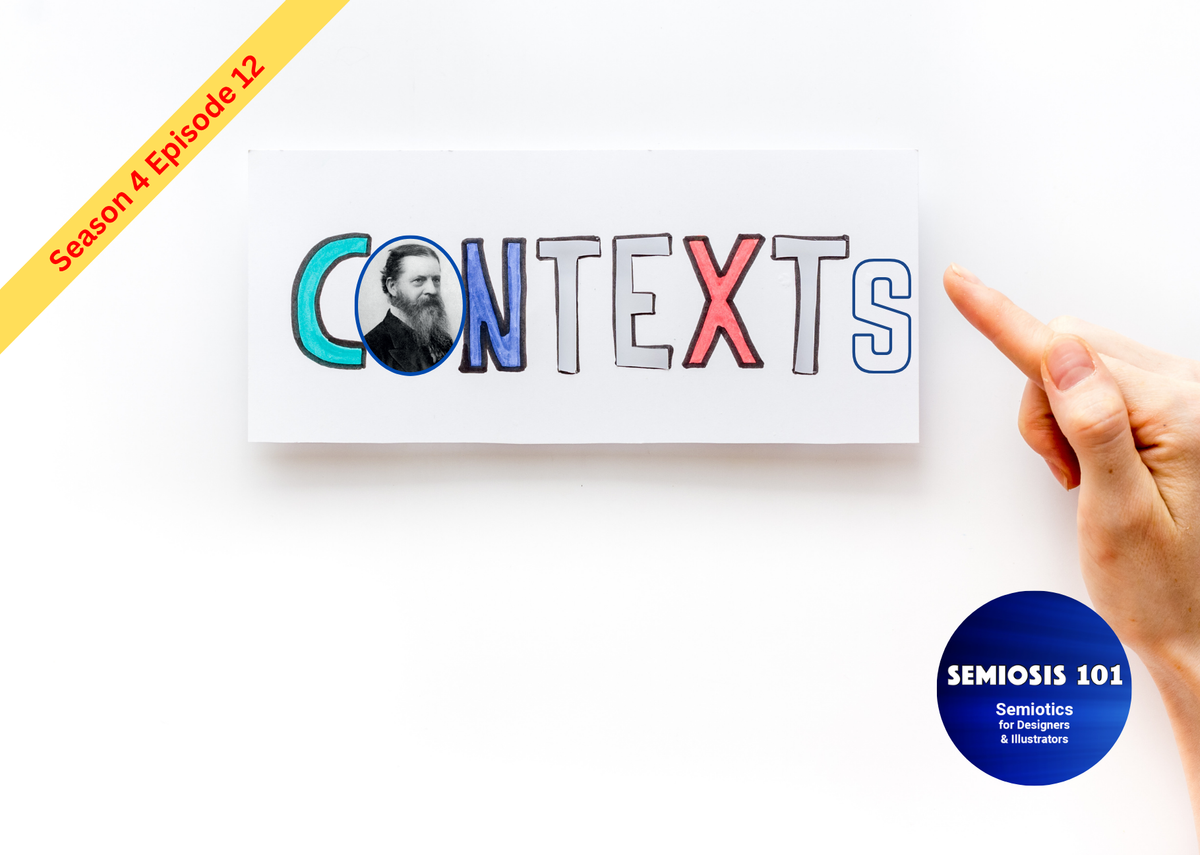
How Do Visual Meaning Contexts Inform CREATIVITY?
Hello readers.
In this free transcript for the episode 4.12 published on Semiosis 101 on Weds 1st October 2025, we will discover how by applying Semiosis (and manipulating its semiotic power levels) will connect with your target audience’s own socio-cultural contexts and reference points.
For any design or illustration, its target audience are individual humans who share common experiences, contexts and behaviour. As illustrators and designers, once you have those clues you can understand how to enhance your own visual communication ability…
Watch the free episode on YouTube for the full impact…
…and here is the episode’s transcript.
How Do Visual Meaning Contexts Inform CREATIVITY?
For any design or illustration, its target audience are individual humans who share common experiences, contexts and behaviour. Once we, as illustrators and designers, have those clues we can understand how to enhance our visual communication ability. We can do this by applying Semiosis and manipulating its semiotic power levels to connect with our target audience’s contexts. Let us see how…
A few episodes back, we explored the contextual impact of audience experiences on meaning. In this 12th episode of Semiosis 101’s season four, we return to this by focussing on contexts informing your ideation. Your audience’s interpretation of the concept they see represented in your visual language, is predicated on a phenomenological “truth” about their lived experience. As Richard Bernstein puts it in his book The Pragmatic Turn, “the world constrains what we believe.”
Klaus Krippendorff in his design book The Semantic Turn, states, “Meanings and contexts are twins, but they behave quite differently. […] Meanings result from seeing something in the context of something else.” Let us now semiotically explore context and meaning within your ideation phase of sketching solutions. We will discover how context informs meaning, and how to visually communicate this.
Last episode we focused on the lowest class of semiotic sign-action. This level of semiotic meaning-bearing was weak and needed to be first perceived before anything is interpreted. Its perception power and visual power of representing the concept, rely on weak qualities to create a sense of familiarity of a possible connection to the intended concept. This possibility is perceived instantaneously, as an effect in the mind of the audience. But it is only interpreted from a familiar quality.
Semiotic sign-action between the concept > representation > interpretation can only proceed once something is perceived as something else. At the instant level of semiotic delivery, this is a semiotic sign that has a familiar quality to hook the audience’s attention. The audience begins to understand that the meaning is different than they had first visually perceived. To interpret meaning from what is visually communicated, the audience subconsciously first draws on their own lived experiences.
That is the contextual knowledge-base they draw on, constrained and informed by the social cultural norms, learnt meanings, and sensed reference points. There is an anecdotal (apocryphal?) story of a rural Anatolian agricultural community who do not posses a visual culture. A horse to them is an existent thing in a field. So much so that they do not recognise an image of a horse as a horse. An image, in their non-visual culture shares no familiar qualities with an existent horse. If true, then you creatives would not want that community as your target audience!
Thankfully, most target audiences will be more visually sophisticated. However, you creatives need your visual language to hook their attention. Hopefully you can see what I am advocating here? As creatives, you semiotically and creatively focus your energies on the representation side. Crafting your visual language to design or illustrate exciting and aesthetically-pleasing designs and illustrations that answer your client’s brief.
This is fine, but what you do as visual communicators is more complicated. Your aesthetic works are not passive. They are not just to WOW the eyes, and make your audience worship you as creative geniuses. So let us put any ego back in its box. As Jorge Frascara succinctly frames it, visual communicators are facilitators of behavioural change in your audience. Your client does not want passiveness.
The client needs audience action! Read this… buy this… do this… go here… avoid that… etc. Your aesthetic attracts your audience’s attention. Semiotics retains it. The aesthetic is composed by your crafting of an appropriate visual language. This visual language (irrespective of media or personal taste) visually communicates the intended concept at a macro and micro level. Like a written language, your visual language has its own visual grammar and syntax.
Your visual language’s complexity is formed by composing lesser visual communication building blocks of shapes, marks, colours, etc. into more complex elements. These building blocks naturally become meaning-bearing when composed together. Does this sound familiar? Good. This is also mapping where semiotic signs apply into your creative practice, as it is the encoded semiotic signs that trigger your audience to interpret meaning.
This triggering of audience perception to interpret what this deeper meaning is, depends on their own contextual knowledge. This context helps you to retain their attention. Let us build a useful scenario to help you grasp this.
Your client’s target audience are cinema goers. The client wants you as a designer or illustrator to connect with them, to facilitate an action where the audience will select their brand the next time they go to a cinema. The ‘tone of voice’ the client wants the target audience to sense from their product is ‘comfortable companionship.’ At a macro level we can frame the client’s brief as…
Concept… their product as a comfortable companion
Representation… you need to convey comfortable companionship
Interpretation… the audience needs to feel the product is something they feel happy to take in with them when they next see a film.
This creative problem will not be solved denotationally, but will require creative skills to convey ‘comfortable companionship.’
How would you, as a designer or illustrator, begin ideating possible solutions at a micro level? Well, sketching ideas is obvious. But how do you research ‘comfortable companionship?’ The cinema-going audience’s lived experiences provide valuable insights. What familiar semiotic qualities will instantly trigger possible feelings of comfort?
Well, cinema-goers feel comfortable in the darkness of a cinema even if they are on their own. This crucial cultural cue to a darkness quality could be the context that informs your creative solution! If you want to read more about this then check out the Semiosis 101 Semiotic Resource on semiosis101.online. Link is below in the description.
In his book on human-centred design, Klaus Krippendorff says, “meanings are invoked by sense, and sense is always part of what it invokes.” Semiosis helps you to invoke meaning. Yes, I said invoke meaning. I could also frame this as semiotically facilitate meaning. This is not the same as Krippendorff’s later criticism of ‘semiotics’ as unreliable, objectivist, individualist, and “caught in first-order understanding.” He criticises semioticians as seeming, “unconcerned with or utterly unaware of how their own terminology constructs the world of signs they claim to study.”
I have some sympathy with Krippendorff’s general thesis in regard to language constructing the meaning, or that this meaning is semiotically set. However, from a Peircean perspective, I argue that if creatives look to the lifeworlds of their audience for contextual clues, the semiotic encoded meaning is not literally set by the creative. Rather the visual language is instead crafted to release different levels of interpretation for the target audience to discover the client’s intended concept.
My reading of Peirce’s semiotic sign-action as I have expressed it in Semiosis 101 episodes, is therefore more naturally aligned with a human-centred approach to visual communication. I do agree with Krippendorff when he concludes that, “the human world is created by human involvement if not design.” The fundamental aspect of Peirce’s Semiosis, is predicated on representation invoking interpretation by the audience, who perceive meaning-bearing visual elements in your visual language.
The audience needs something instantly familiar to begin this semiotic sign-action. Sausserian Structuralist/Poststructuralist Semiology is not my semiotic approach, but as this is built on linguistics I can see how Krippendorff’s bias against semiotics may arise. However, as a Peircean visual communicator I personally feel Peirce has much to offer designers and illustrators to visually enhance how you connect with your audience.
As this episode has outlined, your audience’s lived experience can provide you with many contextual clues to enhance your Communication Power, to trigger their perception power. The easier you make instant visual connections to the intended concept, using familiar qualities that come from insights into their lifeworlds, you can trigger audience’s perception to possible interpretations. Familiar semiotic qualities are the bait you lay to hook attention and trigger interpretation (later this season we WILL be using a Trojan horse metaphor).
In the next episode we will go beyond qualities to get you focussing on understanding audience understanding. So subscribe to be notified when this next free episode is published. Or become a Semiosis 101 Producer on Patreon and watch all future episodes months ahead of YouTube …plus other exclusive Patreon-only video content.
Hint… hint…
Semiosis 101 Semiotic Design Resources is a reader-supported publication. To receive exclusive posts and support my work, consider becoming a free or paid subscriber. Paid subscribers get name checked on all future Semiosis 101 YouTube episodes.
===Semiosis 101 Patreon Producer==============
Become a Semiosis 101 Patreon Producer and get a named producer credit on future video episodes, plus watch all new episodes months ahead of YouTube.
===Semiosis 101 Patreon Exclusives==============
Watch longer Patreon-exclusive Semiosis 101 episodes on applying Semiosis into design and illustration…
PATEXC001 How does semiotics work in illustration?
 Semiosis 101