Free Semiosis 101 Transcript 4.10:
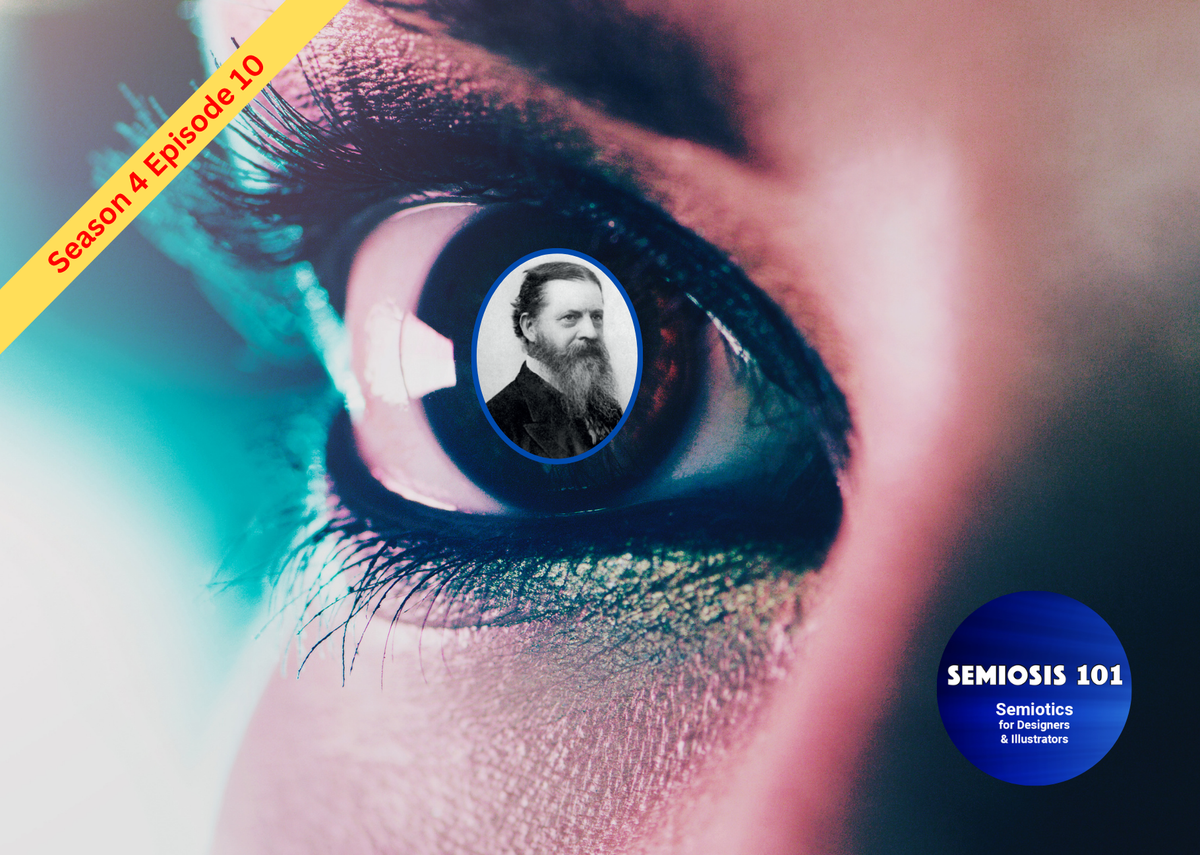
How do CREATIVES REALISE Meaning IS in the Eye-of-the-Beholder?
Hello readers.
In this free transcript for the episode 4.10 published on Semiosis 101 on Weds 3rd September 2025, In How do CREATIVES REALISE Meaning IS in the Eye-of-the-Beholder? we navigate this fluidity of meaning by focusing on how Semiosis can help enhance specific visual communications. The audience provides us with the cultural clues we need to avoid mis-communicating.
From a pragmatic philosophical position, ideas are socially situated and adaptable, AND meaning is culturally agreed and learnt. This has important bearings on you developing your new semiotic frame of mind…
Watch the free episode on YouTube for the full impact…
…and here is the episode’s transcript.
How do CREATIVES REALISE Meaning IS in the Eye-of-the-Beholder?
When we visually communicate something to someone, how effective are we being? We learn that this colour means THIS, and that shape means THAT, but does it really?
Okay, I have asked three questions of you so far, and not just one. We creatives need to ensure whatever we think our visuals are communicating, actually is. Culturally, our audiences can help…
Culturally, meanings are agreed. That is the essence of culture. We do this, see this, think this, and accept this. We are social creatures. We may each do something different and have opinions on what we see that may differ. However, we will share commonalities that are culturally generally agreed to have meaning.
So, in this 10th episode of Semiosis 101’s season four, we navigate this fluidity of meaning by focusing on how Semiosis can help enhance specific visual communications. The audience provides us with the cultural clues we need to avoid mis-communicating.
From a pragmatic philosophical position, ideas are socially situated and adaptable, AND meaning is culturally agreed and learnt. This has important bearings on you developing your new semiotic frame of mind. How do your initial ideas align with your audience? Interpreting meaning is in the Eye-of-the-Beholder, as the audience need mediating to what you want them to interpret.
In your ideation phase of sketching ideas to represent your client’s concept, your visual language develops towards the final aesthetic. However, as we have already discovered, it does not matter how amazing your final aesthetic looks, how beautifully and skilfully you have made it appeal. If the aesthetic miscommunicates its intended meaning to the audience, then it is not the audience that is at fault.
Semiotically, by first appreciating what the audience already have experience of, your ideation will be strengthened with appropriate visual language that conveys the connotational meaning you intend. Your audience’s socio-cultural lived experiences (their lifeworlds) provide you with structured meaning-spaces. These provide insights to what familiar situated qualities they are aware of.
By taking into account these weak familiar qualities, you can craft your visual language from a more informed position. This will help semiotically trigger audience perceptions to interpret deeper meaning, by ideating your creative solutions that answer the client’s brief and connect with the audience.
By re-calibrating your creative mindset to this semiotic approach, your ideation stage becomes more than simple sketching. Ideation becomes a meaning-space where you semiotic encode your visual language’s elements. This aligns your visual communication directly into your audience’s experiences. Semiosis only begins once an encoded element is perceived AS meaning-bearing. Let us call this a semiotic sign (because that is what it is).
By looking at your ideation in this way, every weak element of line, shape, colour, etc. you use to create your illustration or design, IS semiotic. Let us think of these semiotic meaning-bearing qualities as the basic building blocks of your visual communication outcome. They form the visual language to convey the intended concept to the client’s target audience.
The audience’s interpretations are based on their own perceptions, which are embodied in the audience’s lived experiences.Any new understanding the audience gains needs to be mediated by the creative, within a space structured from what is already familiar. Complex meaning can be represented by nesting levels of semiotic signs in your visual language, to facilitate the audience’s perception to interpret the intended concept.
Remember we are discussing semiotics from a pragmatic philosophical position, “which regards the world as being in continuous formation.” This frames the audience’s understanding of meaning as an emergent process of experience-led interpretation, rather than predetermined absolutes. Semiosis is pragmatic and is formed by action.
This semiotic sign-action follows a determination flow that is helical, and rotates through the audience perceiving rounds of concept > representation > interpretation > concept >>> What I mean by this, in Peircean terms, is that once a visual element is perceived as meaning-bearing something; then the audience will subconsciously interpret the visual representation to understand the concept it is visually communicating.
This quest for meaning and understanding will subconsciously continue as long as the audience’s attention is retained. Semiosis is Peirce’s word for semiotic sign-action. It is triadic, as the determination flows through three stages. Each time the audience begins to interpret the meaning within the representation that has their attention, the intended concept is being revealed. This is a a semiotic effect on the mind of the audience.
Let me put this in another way. A philosophically pragmatic way. Peirce builds his pragmatics on Kantian and Hegelian thinking “about how all thinking and reasoning involves mediation and inference.” Peirce clearly is not writing FOR creatives. However, the key skill of any visual communicator through their aesthetics IS mediation. From our visual forms of mediation on behalf of our client’s concept, our target audience take what we infer and cognitively process what they see to understand it.
Peirce’s pragmatics argues that every thought a human has addresses itself to another thought, which determines another thought, and so on. The effects this has on humans is that each thought is a “sign” construct for another connected thought, etc. etc. interpretation is the semiotic effect the representation has on the mind of the target audience.
When I describe your audience interpreting something in your designs or illustrations, this interpretation is provisional. What they interpret are visual meaning-bearing elements or encoded semiotic signs. With each moment of interpretation, an aspect of the concept you are representing in your visual language is being revealed. With each cycle of the semiotic sign-action the audience’s provisional construction of meaning grows toward understanding. The audience subconsciously needs to authenticate the meaning.
If you want to read more about this then check out the Semiosis 101 Semiotic Resource on semiosis101.online. Link is below in the description.
But which meaning? Are you, unintentionally, mis-communicating? What I mean is, does your visual language represent things you certainly do not intend visually communicating? Your target audience have lived experiences (lifeworlds) which provide contexts which help form their interpretations. Semiotic sign-action is singular in delivering the semiotic sign to the audience. Peirce calls this a Sinsign. A Qualisign is the weakest form of delivery of semiotic meaning, as when (IF) perceived its work is complete.
A semiotic quality has triggered perception for the deeper mediation of encoded meaning to begin. In a Sinsign (as in single), the mediation of the concept (through the representation your visual language utilises) is contextual. One audience member may, due to their lived experience, be able to interpret much deeper levels of meaning than another audience member.
Peirce in his ten classes of semiotic sign power details three growing levels of mediated audience perception of what they understand from your visual language (classes 2,3 and 4). The fourth semiotic sign class mediates the visual communication OF direct experience. As a creative, the way to appreciate what this means to you, is to change your creative mindset to understand that interpretation IS contextual. By utilising what you can learn from your target audience’s lifeworlds, you can ideate within their lived experience contexts which inform how they construct meaning.
This will help you to visually communicate your intended encoded meaning, and mediate their interpretations to lead them to the client’s desired concept. In doing so, you reduce any unintended miscommunication. Peirce’s pragmatic semiotic sign-action, helps you through your visual language’s mediation to invoke interpretations that lead the target audience TO the intended concept.
This mediation facilitates the audience to proceed from possible interpretations to suggested meaning. This is achieved because the visual representations of the concept move from the familiar qualities to existential things. The Eye-of-the-Beholder can be semiotically mediated to the intended concept the client needs visually communicating, through hacking into your audience’s lifeworlds.
By understanding these lived experience contexts, you creatives can first trigger their perceptual attention; by utilising in your visual language possibly familiar qualities linked to the concept in their experience. Then your visual elements can suggest more connections to things the audience know that exist, to strengthen their provisional interpretations toward the intended concept’s interpretation.
In the next three episodes, we will unpack this using more creative examples. So remember to subscribe to be notified when these episodes are published. Or become a Semiosis 101 Producer on Patreon and watch all of them now, plus future Semiosis 101 episodes months ahead of YouTube. Patreon Producers get exclusive Patreon-only video content too.
Hint… hint…
Semiosis 101 Semiotic Design Resources is a reader-supported publication. To receive exclusive posts and support my work, consider becoming a free or paid subscriber. Paid subscribers get name checked on all future Semiosis 101 YouTube episodes.
===Semiosis 101 Patreon Producer==============
Become a Semiosis 101 Patreon Producer and get a named producer credit on future video episodes, plus watch all new episodes months ahead of YouTube.
===Semiosis 101 Patreon Exclusives==============
Watch longer Patreon-exclusive Semiosis 101 episodes on applying Semiosis into design and illustration…
PATEXC001 How does semiotics work in illustration?
 Semiosis 101