BLOG 29: Semiotic Material Culture
Semiosis 101 - 5 minute semiotic read
The physical (and digital) outcomes of illustration and design populate our 21st century world. But as humans, from deep within our prehistory, we have evolved abstract thinking and have utilised Symbolic communication. The results of this ability has led to our visual world being populated with physical artefacts (and now digital artefacts). These human-created artefacts offers socio-cultural clues to who made them and who used them and Peirce’s pragmatic semiotic theory helps understand this material culture. Here’s a quick spot test for you 21st century readers…
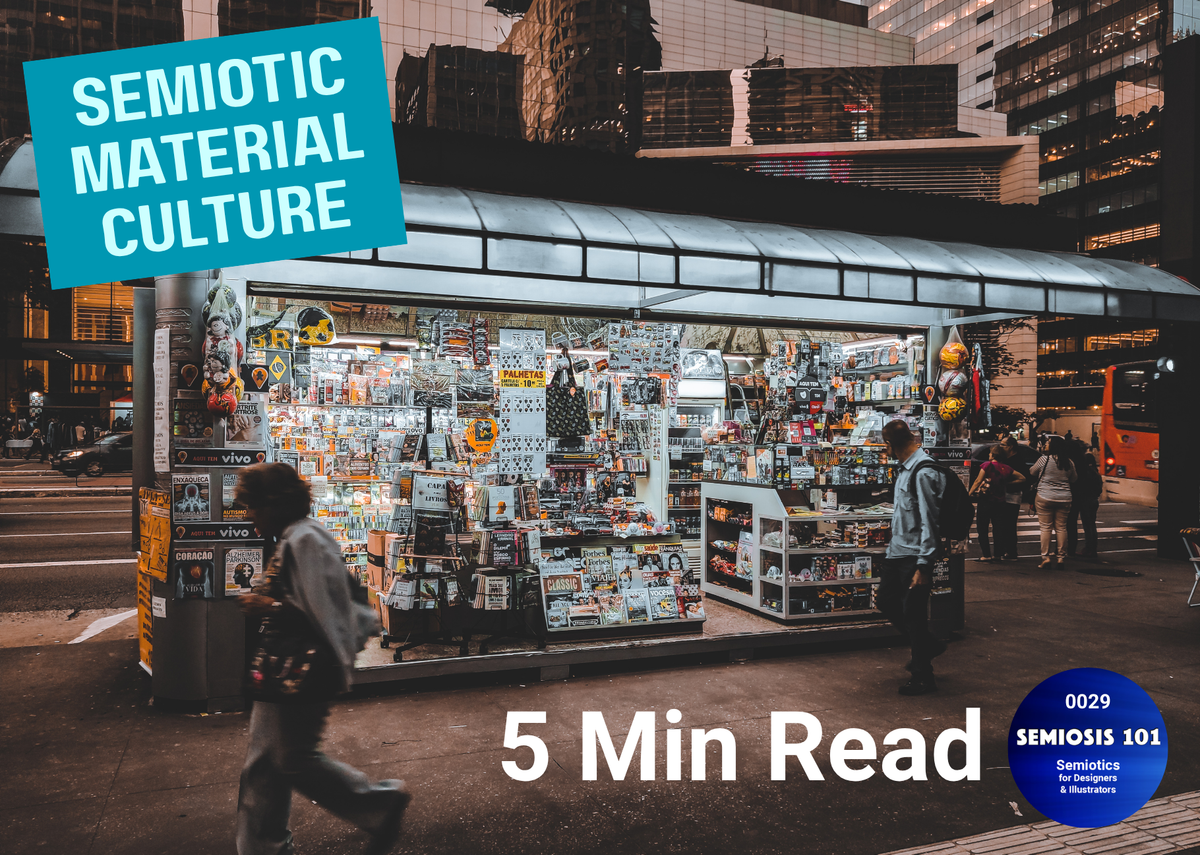
Wherever you are reading this… whatever time of day… try to think back and remember… how many pieces of visual communication have you already seen today?
This could be packaging, tins, posters, signs, newspapers, etc. Can you count them all? These form our current material culture which define us. Do you remember them all? Of course not. Do you consider how this material that surrounds us in our homes, and around us when we go outside, socio-culturally defines us? Well it may
not individually define each person, but collectively it makes a statement about the society we live within. It offers cultural clues as to how we are living our lives.
Societies and cultures naturally are finite, but archaeologists and anthropologists use material culture evidence to understand the society and culture that formed them. Stone Age artefacts are fragmentary, but the visual culture that remains of the cave paintings and mobile artefacts helps us to understand that they were modern humans like us. We may have no written records of the Bronze Age people who worshipped at Stonehenge but we know of them as “Beaker People.”
Predominantly a theory within the archaeological discipline, Material Engagement Theory (MET), highlights human creativity’s relational properties. It conceives that action and thinking are key inter-relational aspects, as “thinking as action” and “action as thinking.”[1] Lambros Malafouris, an archaeologist, proposes that humans evolved our propensity to represent something else - a concept - through signs in the form of marks and imagery as a perceptual scaffolding device.
Malafouris observes that the human brain is as much “an artifact of culture as much as it is a product of human biology.”[2] This abstract advancement in externalising internal thoughts in turn help us Homo sapiens to develop our awareness of self.
MET has a strong pragmatic basis to its structure,[3] and utilises Peirce’s Semiosis over Saussure’s Semiology as the semiotic theory which underpins how material culture semiotically represents meaning. Malafouris’ MET thesis reminds us not to fixate on when Symbolic representation first happened, but rather understanding that a representation of a thing can be a proxy for something else is within us all.
It is possible for humans to think about thinking.[4] The human mind is a powerful entity which cannot be simply explained away as computational processing. The human mind is more than the brain, and our visual perception probes the external world and our internal lifeworld for meaning.
Since human’s began using ‘images’ to represent things, ‘images’ can be thought of as an externalised “continuous prosthetic part” of the mind’s probing and a “cultural extension of the visual brain.”[5] By framing both your and your audience’s minds in this way also reframes how you consider your design’s or illustration’s visual language.
I don’t think it is a controversial point to state that both you and your audience (and client) are human. We all have evolved human minds with a capacity to understand that visual representations can connotatively mean something more than what it initially appears to denote. I believe we are on safe philosophical ground here, however I am not entering into the many philosophical and cognitive arguments about human intelligence, cognition, etc.
Instead I will just restate that Semiosis 101 and my 2026 Semiotics for Designers and Illustrators book are firmly philosophically situated within pragmatic parameters to explain Peirce’s semiotic theory of Semiosis to you illustrators and designers.
Whatever you illustrate or design, it is part of contemporary material culture. Semiosis can positively structure both your visual communication ability and the effect your aesthetic outcomes have on your audience’s culture and society.
[1] Malafouris, L. (2016) How Things Shape the Mind: A Theory of Material Engagement. Cambridge M.A.: MIT Press Books, p235.
[2] Malafouris, L. (2016) How Things Shape the Mind: A Theory of Material Engagement. Cambridge M.A.: MIT Press Books, p236
[3] Preucel, R..W. (2010) Archaeological Semiotics. Chichester: John Wiley & Sons, Ltd.
[4] Malafouris, L. (2016) How Things Shape the Mind: A Theory of Material Engagement. Cambridge M.A.: MIT Press Books, p239
[5] Malafouris, L. (2016) How Things Shape the Mind: A Theory of Material Engagement. Cambridge M.A.: MIT Press Books, p203
 Semiosis 101