BLOG 28: Your Dual-Citizenship of Creativeland and Theoryland
Semiosis 101 - 5 minute semiotic read
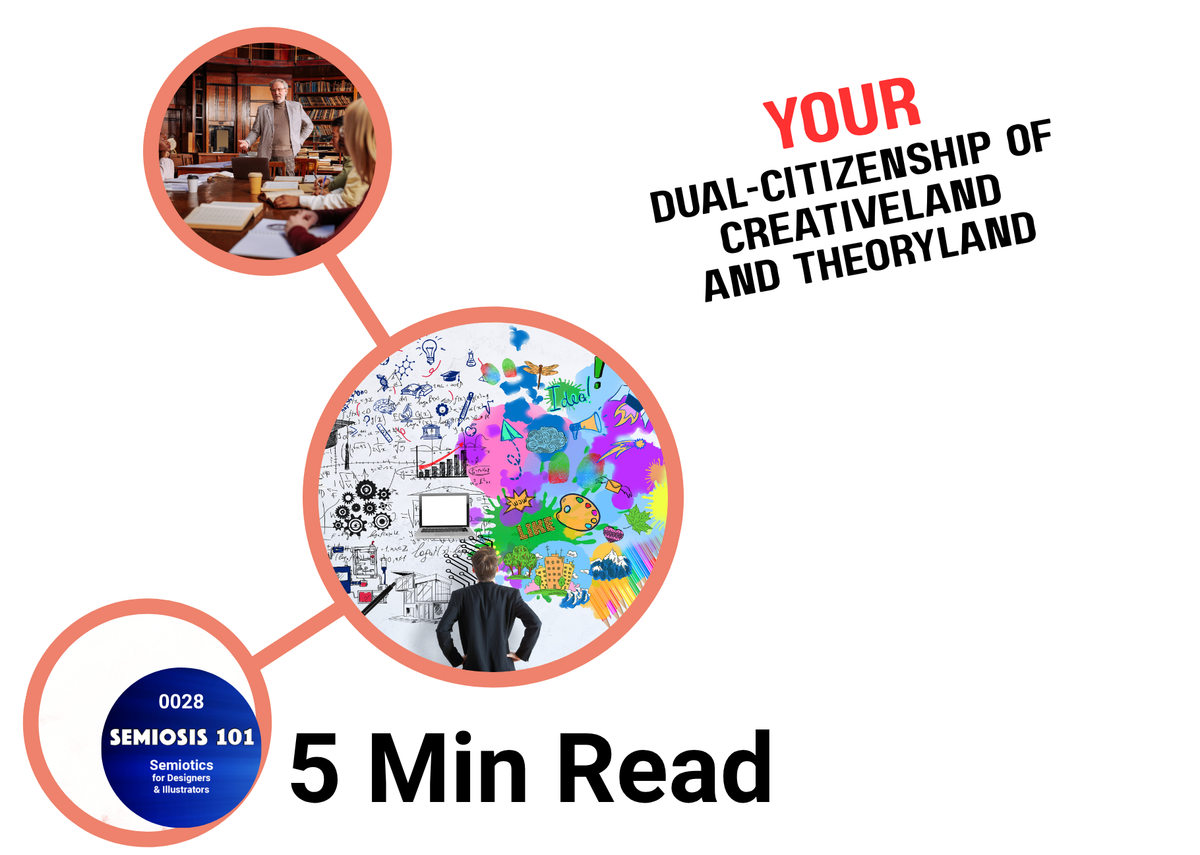
In my 2026 Semiotics for Designers and Illustrators book I use two metaphorical worlds to help bridge the disconnect between visual communication creative practice and academia. These worlds are the colourful tacit world of Creativeland and the more sombre world of Theoryland. The language spoken by the inhabitants in both worlds might as well be the difference between English and Hieroglyphics. But both worlds actually use English.*
(*other languages are available, but this is an English language blog after all!)
To sum up the problem let me ‘hack’ an Oscar Wilde quote from The Canterville Ghost (1887) “Semioticians have really everything in common with designers and illustrators nowadays except, of course, language.” This is why Semiosis 101 exists, as theory is written within academic rules using obtuse terms (especially Peirce) and YOU creatives are not in academia.
With these two metaphorical lands of Creativeland and Theoryland I am leaning heavily into the influence of Winsor McCay’s classic 1920s comic strip, Little Nemo in Slumberland to make an important point. Little Nemo famously had fantastic adventures when he fell asleep that are then forgotten when awakening back into his reality. Just like McCay’s Slumberland, Theoryland to you is a foreign place that is both wonderful and yet very confusing.
As illustrators and designers, you have been
educated in art colleges and design schools. You exist in Creativeland. During your education you will have been exposed to many useful theories. These will have helped develop your creative abilities at deeper levels. These theories may include psychology, colour theory, Gestalt theory, etc., but as you aren’t educated as theoreticians, this theory is only basic.
As soon as you creatives attempt to gain deeper theoretical understanding of relevant paradigms and research methodologies, you are lost before you begin. You may directly or indirectly apply theories into creating your illustrations or designs. But can you fully explain what you did? Your knowledge can be described as tacit knowledge – “knowledge we cannot tell.”[1]
You gain this knowledge through practical work, experience, and what can be deemed ‘gut instinct.’ Your development mostly comes from the design studio, in what essentially is a constructivist approach of learning-through-doing. When turning to theory to explain what you have done you are constrained, as theory is seldom written for a creative.
Theoretical language is expressed within the limitations of Theoryland, in an academic system that can quickly alienate the untrained creative and restricts their ability to apply it. The complexity of theoretical terminology is a barrier, and this I why Semiosis 101 is here as your Semiotic Rosetta Stone to interface between Theoryland and Creativeland. I advocate for theory-in-Creativeland, in other words for theory to be creative-centric. What I am highlighting is a theoretical conundrum.
For you creatives to apply theory you need to understand theory. However if theory is only written by theoreticians in language theoreticians understand, you will never understand theory to apply it. Therefore, theory needs to be contextualised to creative practice to apply it, and there is the impasse in this Theoryland/Creativeland conundrum. Theory needs to be contextualised in and explained by using the language of Creativeland. This is the aim of both Semiosis 101 and my 2026 book - theory in plain language that ensures its application.
Too often when creatives do try to contextualise theory into design or illustration practice, they fall into Theoryland’s trap for creatives. I have been trapped in this way many times. Let me explain with a translator example. A good interpreter doesn’t just know two different languages, they will also understand the socio-cultural nuances of the non-speaker’s situation.
A translator does not confuse the non-speaker by just speaking the foreign words in an accent instead of translating them. They will use the words and situational contexts known to the non-speaker for them to understand what is meant. To explain theory to non-theoretician creatives in Creativeland you don’t situate yourself within Theoryland and speak in academic language.
This is why I have situated Semiosis 101 firmly in Creativeland in order to translate Peirce’s pragmatic semiotic theory to you designers and illustrators.
[1] Polanyi, M. (2009) The Tacit Dimension. Chicago: The University of Chicago Press, p5.
 Semiosis 101