BLOG 27: Peircean Iconic, Indexical, Symbolic Explained
Semiosis 101 - 5 minute semiotic read
The concept that you need to connotatively visually communicate through the visual tone of voice you set is important. Peirce calls this the “Object,” but to contextualise his obtuse terminology into your existing creative practice, we will refer to it as the “concept” that is in your client’s brief. Semiotically this concept (Object) is either immediate or dynamic.
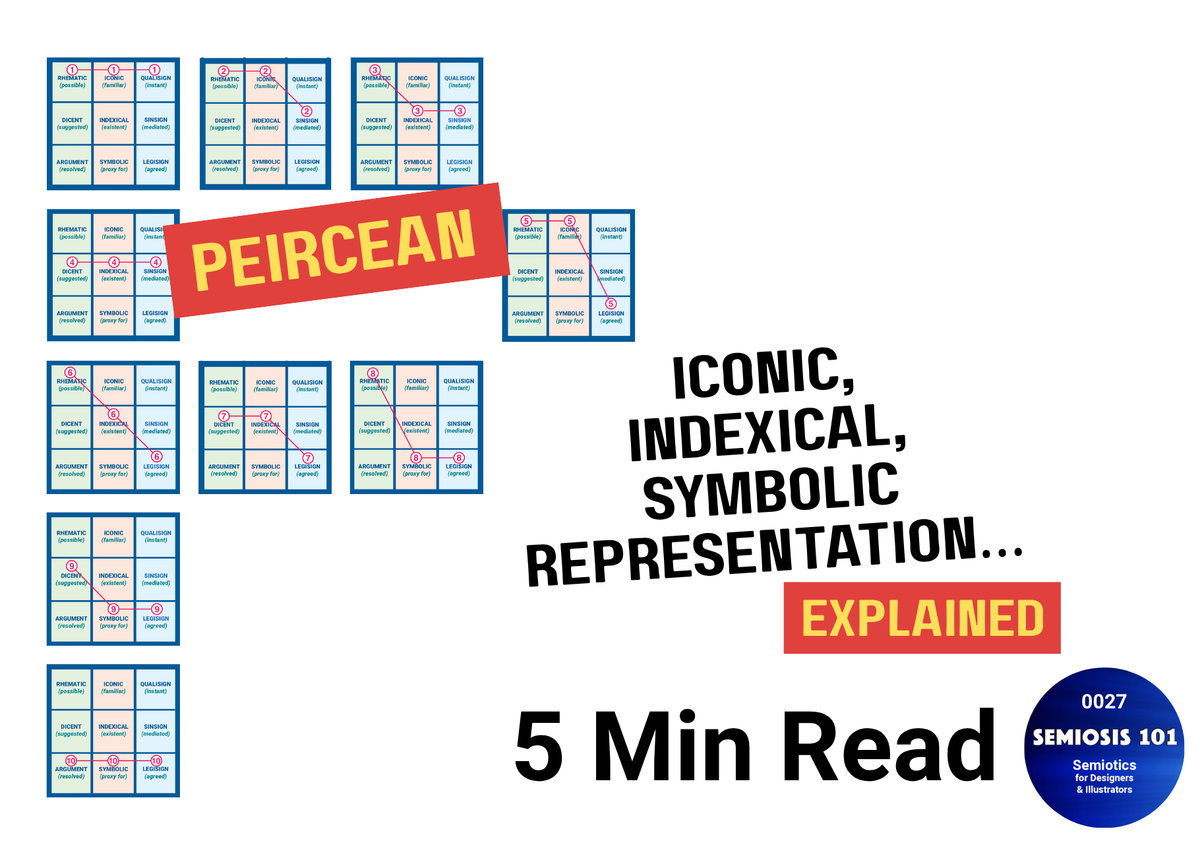
How your audience will perceive the concept within your visual language semiotically structures your visual communication. Its Communication Power is structured through three levels of representing the concept: Iconic representation, Indexical representation and Symbolic representation.
To use plainer language, this means that to semiotically mediate the concept in your design’s or illustration’s aesthetic, your visual language relies on
visual possible familiar visual qualities (Iconic), or suggest existent things (Indexical), or socio-culturally agree visual proxies for (Symbolic) the concept. Peirce also describes the main triadic structure as triadics of Comparison, Performance and Thought.[1]
The crucial aspect behind Iconic representation of the concept is that once a thing (e.g. a line, a colour, a shape) is perceived as meaning-bearing, it puts an idea of some other thing into the mind of your target audience. Iconic representation is always in a state of Firstness and this is why Peirce also uses the term “Comparison” when explaining what happens in Firstness.
An Iconic representation of the concept cannot represent the intended concept in its entirety, but only as a facet of a quality of the concept which uses familiarity and resemblances, to make the possible connection in the minds of the audience. These familiar qualities equate to how you use basic visual elements as visual communication building blocks.
A simple mark is just a simple mark. But shaped in a certain way, and composed with other marks, it could possibly resemble hair, or a tree, or a car, etc. But it still remains a mark. Once its familiarity is perceived, the Iconic effect on the audience is for them to begin to interpret it as resembling something they have prior experience of.
Once it begins to suggest existent things by single interpreted hits of meaning, then that meaning is being mediated. This is a semiotic “Performance” in a perceptual state of Secondness.
By perceiving a mark and interpreting it as bearing a resemblance to the visual quality of, say a tree branch, then the same visual element (composed with other tree-like marks) is working at a level of Indexical representation of the concept.
Just like an index finger is used to point at things, Indexical representation of the concept helps the audience to interpret what they see as connecting with existent things. These things can be living, breathing things, or things as ideas, imaginary things, etc. Daniel Chandler summarises that “Indexicality is based on (at least perceived) ‘direct connection’” with the concept.[2]
Indexical representation semiotically builds on the nested Iconic representational meaning-bearing elements, to facilitate interpreting the direct connection to an existent thing.
Indexical representation of a concept is a crucial component in visually communicating, and its principal is already embedded in the work you do. The simple marks you make (Iconic) are intended to work in a composed way to perceptually POINT to things such as a tree (Indexical). Your visual language is now performing.
Symbolic representation of the concept transcends any individuality of meaning. As a Symbol is interpreted as a proxy for the concept, its agreed meaning is semiotically general in how the target audience resolves how to interpret it. As Tony Jappy says, “we have to learn it.”[3]
Symbolic representation either has to utilise visual socio-cultural tropes already in common use which the audience will already be aware of; or they need to learn how a visual thing is a proxy for something else. This is learnt through cultural socialisation by the audience. Still confused? Consider how a logo works. A visual identity mark has to be socio-culturally learnt that THIS (logo) means THAT (organisation/product).
Symbolic meaning grows “according to usage and the experience”[4] of the audience’s ability to think in a state of Thirdness. Check out my Semiosis 101 playlists on YouTube, or read more about this in my 2026 Semiotics for Designers and Illustrators book.
[1] The Peirce Edition Project. Eds. (1998) The Essential Peirce, Volume 2: Selected Philosophical Writings (1893–1913). Bloomington: Indiana University Press, p289.
[2] Chandler, D. (2007) Semiotics: The Basics [2nd Edition]. Abingdon: Routledge, p37.
[3] Jappy, T. (2013) Introduction to Peircean Visual Semiotics. London: Bloomsbury, p91.
[4] Jappy, T. (2013) Introduction to Peircean Visual Semiotics. London: Bloomsbury, p103.
 Semiosis 101