BLOG 22: Second-order Thinking and a Semiotic Mindset
Semiosis 101 - 5 minute semiotic read
Why does your visual communication sometimes miscommunicate?
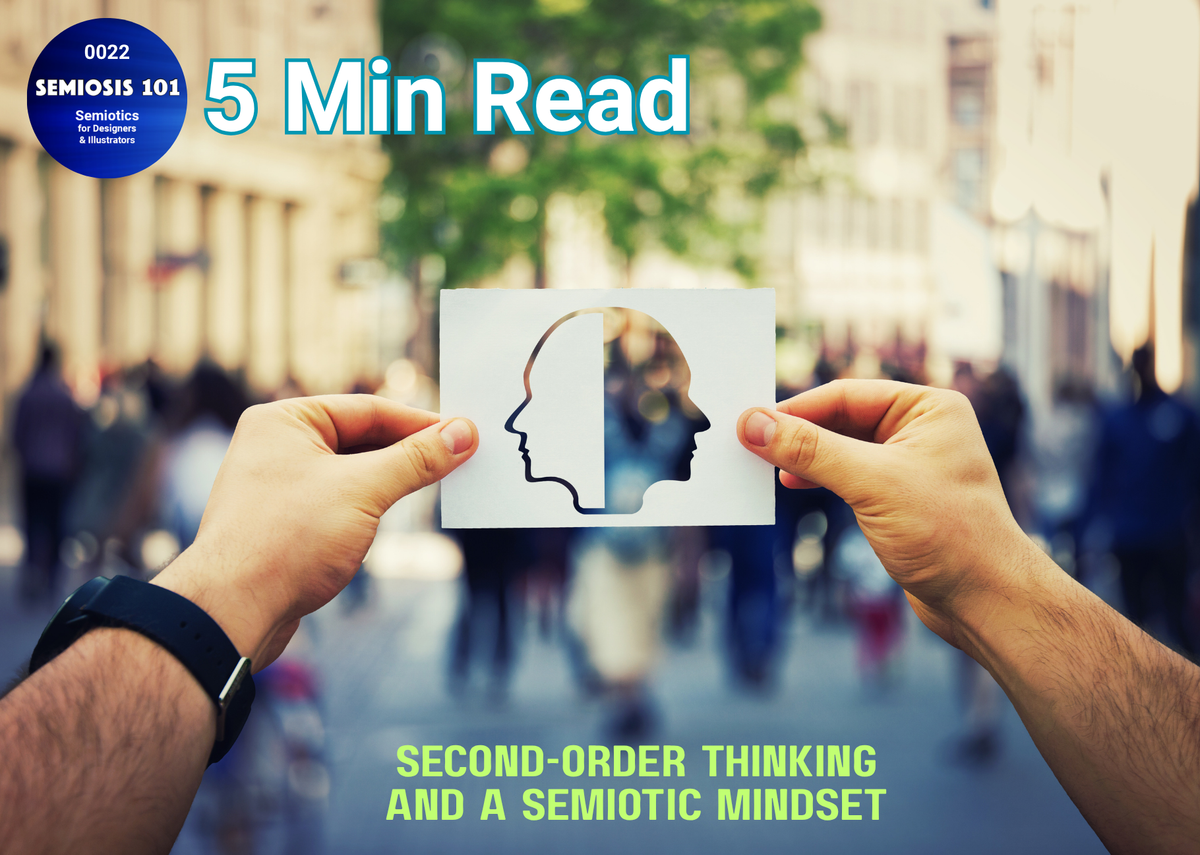
Do you design or illustrate for yourself first or do you consider your audience? The difference between these two positions is a factor in miscommunication. We can frame this binary as first-order thinking versus second-order thinking, or as a god-view versus a holistic and empathic approach. The act of visually communicating is to transmit meaning. It is proactive and entails a communicational situation between you the creative and your target audience on behalf of your client.
Second-order thinking triangulates your creative decisions between what your client needs and what
your audience will understand. The god-view of first-order thinking assumes that just because you know what your design of illustration is about everyone will. A pragmatic semiotic mindset benefits from adopting an empathic second-order thinking approach to visual communication. First-order thinking is assuming that everyone else sees the world as you do. First-order thinking IS a god-view of how you believe the world works, based on YOUR own assumptions and personal biases.
A small change in your mindset as a creative is crucial for you to make more visual communication impact. We are never illustrating or designing for ourselves. Artists pose questions, designers and illustrators solve creative problems. An illustrator and designer can also be artists, but within a commercial application of your skills you naturally are first a problem solver between your client and your audience.
This is where adopting second-order thinking is crucial, and Semiosis helps you to semiotically structure your visual language to enhance how you visually communicate. A working Hypothesis on your target audience helps you to understand what your audience already has experience of.
Understanding these audience insights helps you to hack your visual language decisions and enhance how your aesthetic attracts and retains their attention.
In other words, how your audience interprets meaning is based on their lifeworld of previous knowledge and experience which you have to consider. Krippendorff states that, “every conception is someone’s conception.”[1] In pragmatism, pragmatists argue that everyone’s future interpretations are based on their own previous understanding.
Knowledge is learnt whether by personal study or socio-cultural influences and consensus. By utilising a working Hypothesis of what your audience already visually understands, provides you with semiotic “hacks” straight to retaining their attention after triggering their perception.
We can call this realisation second-order thinking. Pragmatic second-order thinking provides you illustrators and designers with a valuable edge, to semiotically enhance how you visually communicate to your audience. Your act of forming a working Hypothesis, of how your target audience already experiences things-in-the-world, forces you to build your understanding of what your audience already understands. This is why I reframe the audience as knowledge agents.
As creatives, it is important to understand that for your audience to perceive meaning, they draw on their lived experiences; as they have, “lived through their own history of conceptualizations.”[2] Second-order thinking is empathic and changes your point of view to see design solutions through audience lifeworlds. A pragmatic semiotic frame of mind treats the aesthetic as proactive, rather than classically passive.
As visual communicators, your illustrations or designs bear meaning. This structured pragmatic semiotic sign-action has some effect on your audience who perceive the aesthetic, as the visual language you use in your designs or illustrations facilitates audience reaction.
By bringing yourself closer as you ideate, to what the audience’s lived experiences reveal about what the initial qualities they will find familiar, you open up a working dialogue. This is a Frascaran communicational situation where different understandings can co-exist to discover what will semiotically attract and retain audience attention.
Such a creative communicational situation in which your proximity to understanding audience lived experiences, exposes you to strengthen your semiotic mindset too. By seeking dialogue through a working Hypothesis, you naturally break out of first-order thinking into second-order thinking.
Your enhancement will develop by developing your semiotic mindset within a perspective of proximity to your audience. By understanding their lived experiences, you can gain insights to how you can visually align the concept you need to visually communicate, to what the audience is already aware of.
I explain more about communicational situations and working Hypothesis in my 2026 Semiotics for Designers and Illustrators book. Also check out my Hypothesis playlist of Semiosis 101 episodes on YouTube.
[1] Krippendorff, K. (2006) The Semantic Turn: A New Foundation for Design. Boca Raton: CRC Press Taylor & Francis Group, p49.
[2] Krippendorff, K. (2006) The Semantic Turn: A New Foundation for Design. Boca Raton: CRC Press Taylor & Francis Group, p275.
 Semiosis 101