BLOG 19: Semiotically Designing and Illustrating With Hypothesis
Semiosis 101 - 5 minute semiotic read
When we design or illustrate it is essentially for an audience. As the creative you are certainly creating something from your inherent creative skills, using tools and techniques you have spent time perfecting. However, I am not discussing ‘making art.’ I am discussing how to semiotically enhance your ability to visually communicate to other people from the aesthetic work you create. Will your audience understand that your aesthetic is actually visually communicating something to them? Will they misinterpret your visual language decisions and perceptively come to unintended conclusions?
Effective visual communication is semiotically in your control. After all you creatively control
how meaning is being mediated. This is where understanding your audience’s socio-cultural reference points is desirable in order to enhance how you visually communicate. The pragmatic tools you need are Abductive reasoning and a working Hypothesis.
Albert Atkin refers to Peirce’s Abductive reasoning, “as a form of guessing or inference to the best explanation.”[1] Peirce defines Abductive reasoning as “a method of forming a general prediction without any positive assurance that it will succeed.”[2]
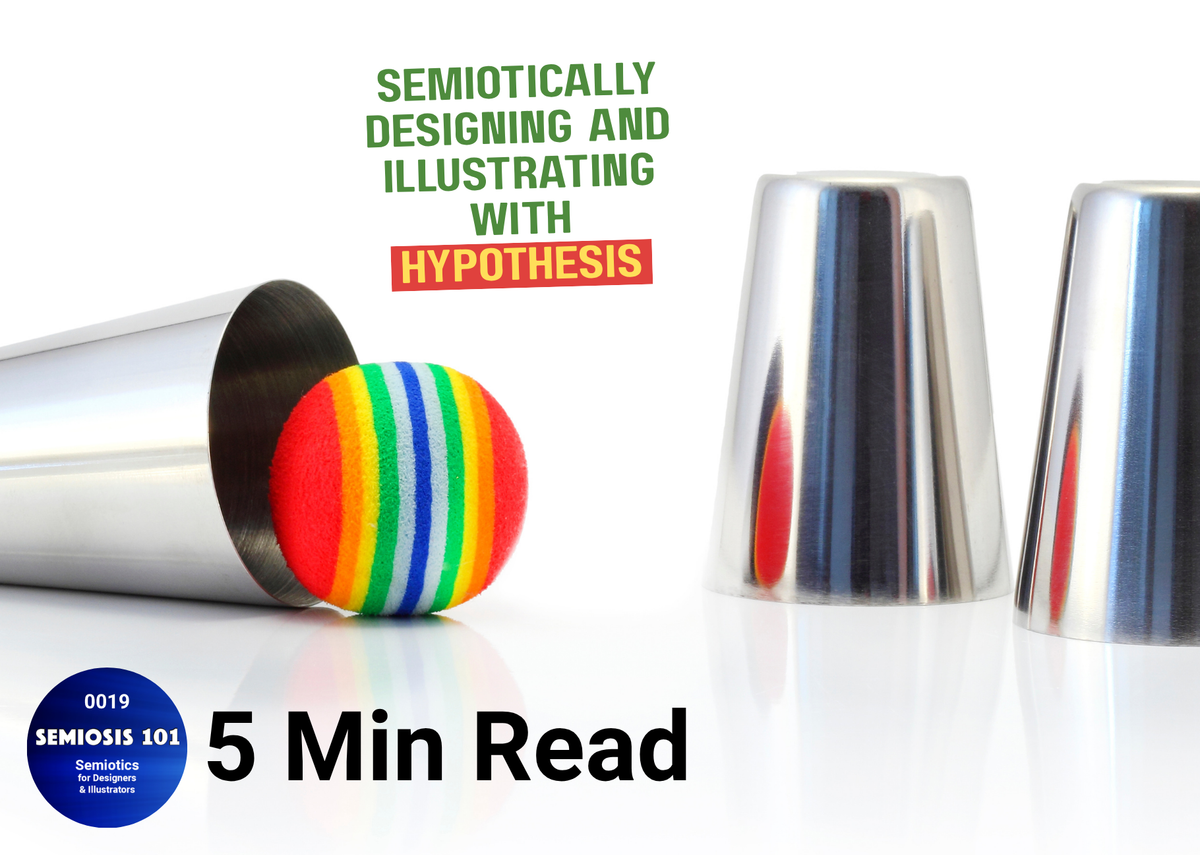
A working Hypothesis is formed from the best current truth about your audience until more is known. It is a form of logical thinking that has been described as the Logic of Design. Peirce defines three forms of logical reasoning: Deduction, Induction and Abduction.
Due to Abduction’s other meaning in non-logical contexts I prefer to use the more accessible term Abductive reasoning; and Peirce himself uses the term Hypothesis when he discusses Abductive reasoning. Abductive reasoning is very important within Semiosis, as by applying it you can reveal important insights about your target audience’s reference points.
Peirce states that an “Abductive suggestion comes to us like a flash. It is an act of insight, although extremely fallible insight. (…) It is the idea of putting together what we have never before dreamed of putting together which flashes the new suggestion before our contemplation.”[3]
When you are beginning any new brief as an illustrator and designer, your design’s or illustration’s aesthetic is meant to visually communicate something to your target audience. In other blog posts, in the video episodes and in my 2026 book I stress that we connote deeper meaning through the aesthetic we create.
Your aesthetic is not passively denoting beauty to be admired. Instead your aesthetic is proactively meaning-bearing, visually connoting deeper meaning in plain sight for the audience to interpret. Therefore your audience are important to your ideation.
Your audience won’t understand what you are visually communicating if you don’t factor in their socio-cultural reference points. As an example of what I mean, if you were designing an illustrated picture book for toddlers ,or an assisted-living booklet for senior citizens then you would temper your visual language decisions accordingly. You would consider you target audience when ideating visual communication solutions.
Abductive reasoning (a working Hypothesis) aids you to understand your target audience. This begins with simple facts, and as your understanding of the audiences socio-cultural reference points increases, your audience working Hypothesis grows.
Your Hypothesis is not simply ‘educated guesses.’ Cornelis de Waal advocates these guesses must consider as many, “relevant facts as possible” and that “past experience and other beliefs”[4] help you to deny or confirm your working Hypothesis. As designers and illustrators, the more insights you can gather about your audience’s prior experiences will be beneficial.
These insights can reveal subtle socio-cultural contextual qualities which can help you in your early ideation to semiotically increase Iconic familiarity and resemblances that will resonate with your audience in your aesthetic’s visual language.
You do not need a budget or audience research marketing teams to use Abductive reasoning when you ideate. If you are designing a picture book for toddlers the first Abductively reasoned insight is that the toddlers cannot read yet. From that ‘fact’ you can develop a working Hypothesis about what else toddlers can or can’t do, what will visually appeal to them, etc. This Abductive reasoning approach is scalable and semiotically applicable to any target audience and any form of visual communication.
Check out the Hypothesis playlist of Semiosis 101 episodes on YouTube. My 2026 Semiotics for Designers and Illustrators book also explores and explains Abductive reasoning methods to when ideating.
[1] Atkin, A. (2016) Peirce. Abingdon: Routledge, p296.
[2] The Peirce Edition Project. Eds. (1998) The Essential Peirce, Volume 2: Selected Philosophical Writings (1893–1913). Bloomington: Indiana University Press, p299.
[3] Peirce, C.S. (1934) The Collected Papers of Charles Sanders Peirce. Vol. 4 The Simplest Mathematics. Cambridge: Harvard University Press, 5.181.
[4] de Waal, C. (2013) Peirce: A Guide for the Perplexed. London: Bloomsbury, p64
 Semiosis 101