010: Spotlight on the book's structure
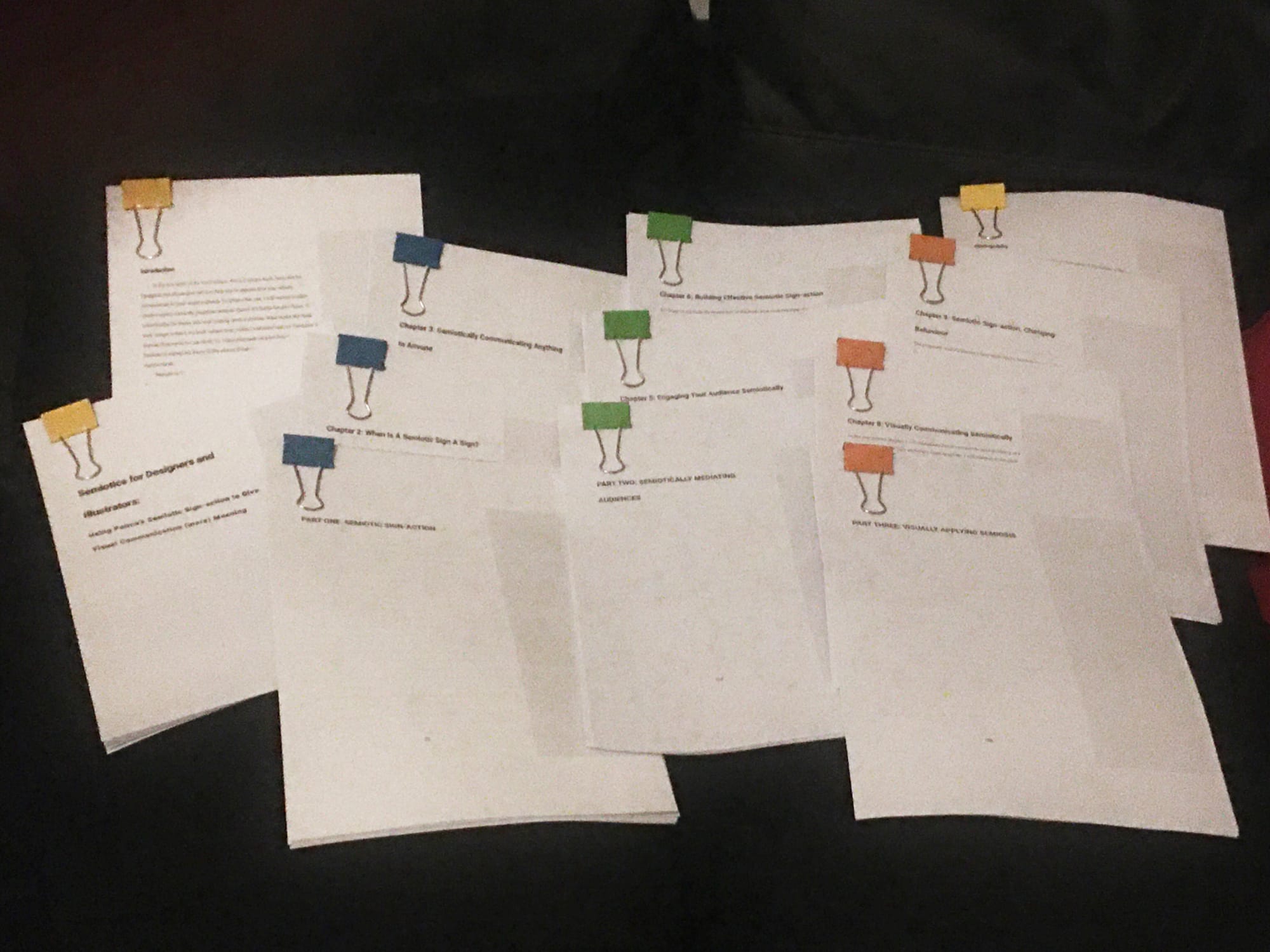
First raw and chaotic draft
Semiotics for Designers and Illustrators (2026)
I have described in earlier posts that my decisions to structure my new book mirrored the triadic nature of Charles Sander Peirce’s theory of pragmatic semiotic sign-action. In this way my book has three parts of three chapters. Nine chapters in total.
Each chapter has three main themed segments that walk the reader through the theory to apply it into creative practice. To aid the reader’s own learning style, each chapter has three ways to explain the theory. The first main way is in the creative-centric plain writing of the main chapter text. This is visually supported by visual examples or bespoke diagrams and captions.
While my book’s main text is written for creatives, when a Peircean term is first referenced in the main text, I introduce a more creative-centric meta-term to contextualise the explanation into creative practice. As well as introducing each meta-term I use the theory box outs to summarise Peirce’s original term. In these box outs I cite Peirce’s writing plus other Peircean semioticians work on his theory. I provide academic references to this Theoryland literature that Creativeland readers can go on to read themselves.
This was always an important feature of my proposed book. While it is crucial to make a Creativeland-situated book on theory readable to illustrators and designers, it is also crucial for designers and illustrators to be exposed to the Theoryland literature. When researching my PhD I had to do all this contextualising of Peirce to creative practice myself, as at the time there wasn’t any Peircean semiotic books written for illustrators or designers. Therefore, I wanted to write that book to ensure that those creatives following me into Peircean semiotics had an easier research path to follow.
As a socialist I am a firm believer in paying benefits forward to the next generation. If you have successfully climbed ‘the ladder’ then you do not pull it up behind you. Instead you add extra rungs at the bottom of ‘the ladder’ for those following. In this way the theory box outs provide my readers with mini literature reviews I wished I had when I first struggled with understanding Theoryland literature as a creative.
The main flow of the three parts of my book first begins with a cycle of three chapters to help you to understand Peirce’s semiotic theory in the context of your own existing design or illustration practice. Then in the second part of the book I cycle deeper into the theory in the context of understanding your target audience and how they will perceive what you are semiotically visually communicating. I describe these two parts as your guided excursion into Theoryland.
In the final part we return to Creativeland where the final three chapters explore methods to use to apply your new pragmatic semiotic mindset to enhancing how you visually communicate.
Spoiler alert: there is an eight-point semiotic manifesto for creatives in the final chapter.
If you want to be amongst the first to read my book in 2026 I will be posting some exclusive Bloomsbury discount codes in this newsletter nearer publication date.