009: My writing process… my creative-centric meta-language
First raw and chaotic draft
Semiotics for Designers and Illustrators (2026)
What do I mean by my creative-centric meta-language?
My new Semiotics for Designers and Illustrators book is a theory book contextualised for illustrators and designers. As I argue throughout the book, theory needs to be written in plain language that non-theoreticians can read and understand. Illustrators and designers are visual communicators situated within Creativeland. They are not natives of Theoryland so the academic language used by theoreticians is unhelpful. Contextualisation does not mean ‘dumbing down’ the theory by any means.
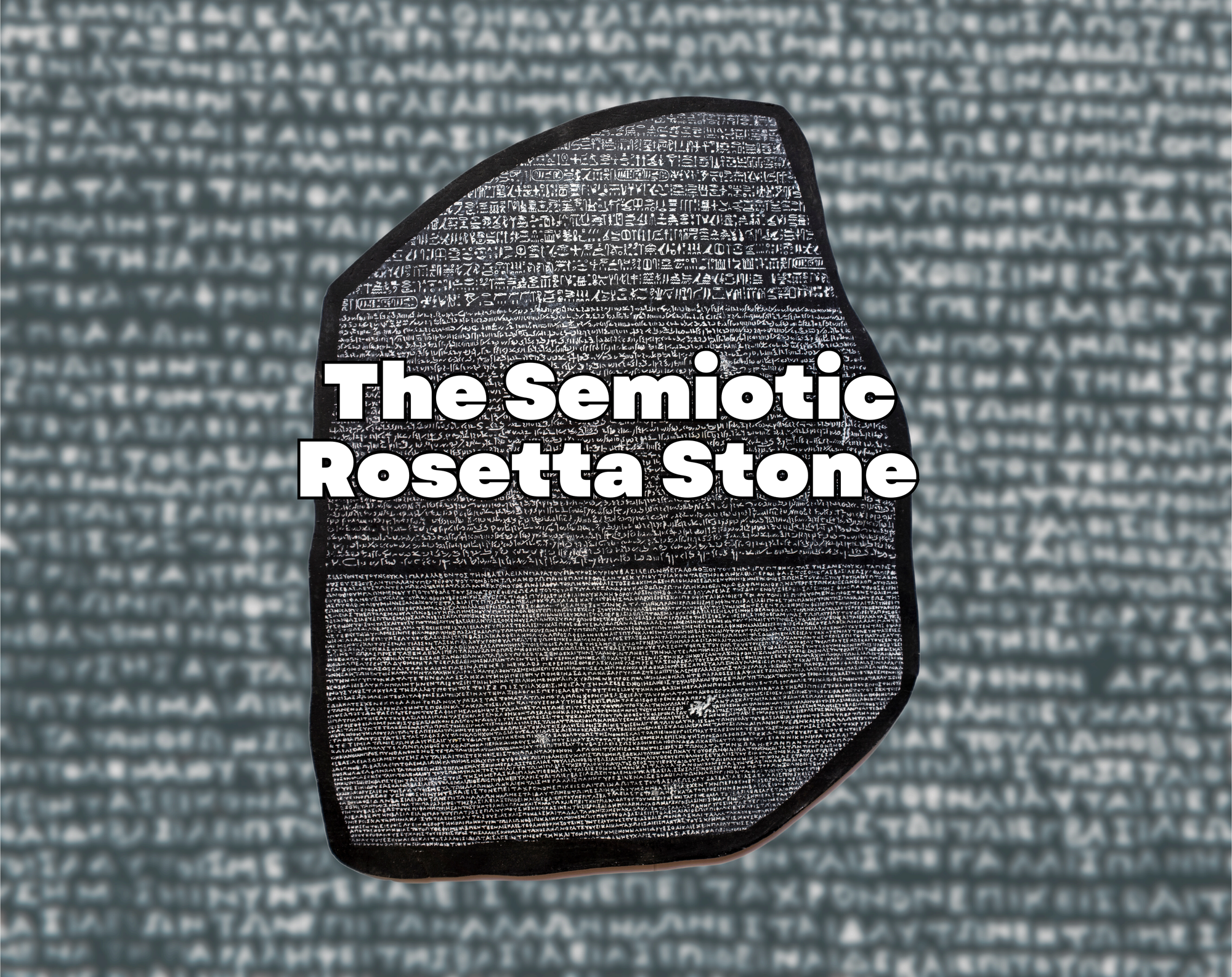
If creative’s don’t understand the language that theory is written in, then they won’t benefit from the theory. The joke of the English abroad talking English to non-English speakers in ever louder voices to be understood is essentially what happens with Theoryland. The repetition of foreign terms does not mean that eventually theory will miraculously be understood. This is why I frame my ongoing design research under the umbrella term of a Semiotic Rosetta Stone.
To contextualise theory into visual communication practice needs its explanations situated in that practice. However, when that practice includes design then some of Charles Sander Peirce’s key pragmatic semiotic terms cause nomenclature confusions. Many of Peirce’s obtuse terms are terms he devised or appropriated in the late 19th and early 20th century America. He used these terms to essentially make his own theoretical arguments clear.
Peirce was a polyglot. He was the founder of the philosophy of Pragmatism and was a mathematician and logician. Science was his focus, so his terminology reflects these quantitative roots. But his theory was also based in phenomena, and phenomenology (and Visual Communication Design) is strongly qualitative. His use of Icon and Symbol to describe aspects of semiotically conveying an Object immediately causes problems in 21st century creative practice, where they now are associated with graphic devices for interface navigation. Even Iconic is socio-culturally used to describe classic references of everything from artefacts, buildings, engineering to existential moments.
Just as the historic Egyptian Rosetta Stone helped translators to finally understand hieroglyphics, my book performs the same service for illustrators and designers to understand Peirce’s Semiosis. The original Rosetta Stone featured the same text written in three forms: Ancient Greek, Demotic Script and Hieroglyphics. Greek was known to the translators, so through using the Demotic script (a cursive form of Hieroglyphics) as a meta-language, they broke the code.
The creative-centric meta-language I use in the plain text of the book follows this approach as a bridge between Creativeland and Theoryland. All of Peirce’s key terms in pragmatic semiotic sign-action have a simpler meta-language term. Many of these meta-terms are from his own explanations. Let me give you a teaser to how my creative-centric meta-language helps you to understand Peirce’s theory.
A key point is that Semiosis has three nodes that forms a semiotic determination flow from no meaning to visually communicated meaning. Peirce names these three key nodes as…
Object > Representamen > Interpretant
…or, using creative-centric meta-language terms…
concept > representation > interpretation.
Which do you prefer?
As designers and illustrators you discover what needs visually communicating (a concept) from your client’s briefing. Your illustration’s or design’s aesthetic connotes this concept in how your visual language decisions represent aspects of it to your target audience. This is where semiotic sign-action mediates connotative meaning to the audience, but it is up to the audience how they interpret what they see, whether successful visual communication of the concept has been made. This is the determination flow that happens at the micro level of ideation and perception. If it is useful to you creatives, you can think of Peirce’s key determination flow at a macro level as the relationship between your client, you (the creative), and your audience.
This creative-centric meta-language is the approach I take in my book to be true to both Peirce’s theory (Theoryland) and to your creative practice (Creativeland).
If you want to be amongst the first to read my book in 2026 I will be posting some exclusive Bloomsbury discount codes in this newsletter nearer publication date.