008: My writing process… my bespoke semiotic diagrams
First raw and chaotic draft
Semiotics for Designers and Illustrators (2026)
Although Charles Sanders Peirce conceived his pragmatic semiotic theory of Semiosis which can enhance how you visually communicate, he didn’t write with you designers and illustrators in mind.
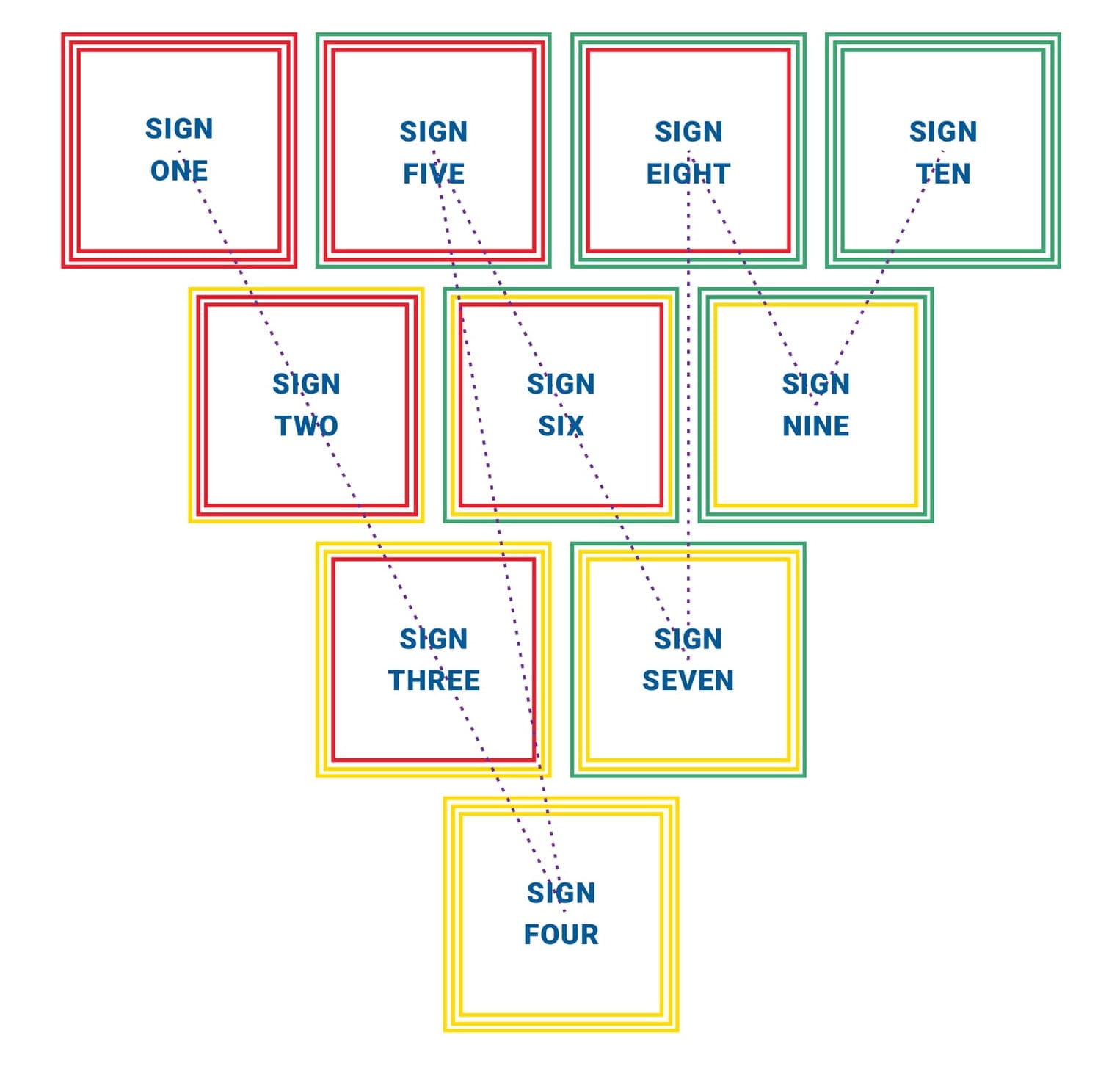
If you flip through books written by Peirce and commentaries by Peircean semioticians you will see diagrams. The most common diagram is the inverted triangle Peirce uses to explain his ten semiotic sign classifications. I will be honest here that I personally do not find the majority of the existing diagrams in the literature useful. Apart from being a creative I am also dyscalculic. I found the existing diagrams were too unfamiliar for designers and illustrators in explaining key components of sign-action and pragmatic thinking. The existing diagrams were very visually dry, ‘mathematic,’ and ‘philosophic’ in nature.
Peirce WAS a mathematician, logician and a philosopher who was one of the founding fathers of Pragmatism, a philosophy based on action. His aim was to make scientific truth clearer., To achieve this clarity of pragmatic thinking meant that he coined specific terminology, which ironically made his writing more obtuse. Peircean writers acknowledge this problem, but as their natural environment is Theoryland, they naturally use Peirce’s terminology when explaining Peirce’s semiotic theory.
As I argue in my book this conundrum is not helpful to creatives who are non-theoreticians whose natural environment is Creativeland. This is where Semiosis 101 on YouTube and Patreon, plus my new book, find a creative-centric way to explain and contextualise complex philosophical semiotic theory. As my book explains pragmatic semiotic sign-action in plain language, I translate Peirce’s obtuse terminology using a sort of semiotic meta-language that interfaces between theory and practice. In support of this plain text, I also have designed many new diagrams to explain facets of his semiotic theory in the context of visual communication.
As a visual communicator I decided it was crucial to redraw key diagrams and create completely new diagrams that contextualised the theory using the language of Creativeland. As well as these 30 bespoke diagrams in the book, I also created 11 Little Creative in Theoryland ® infographic strip. While the diagrams are referenced in the text and they work hand-in-hand with that narrative, the Little Creative strips utilise the graphic novel format to explain key issues to explain how to apply the theory into existing creative practice.
In fact, several of my book’s bespoke diagrams are also featured in these strips as Little Creative struggles to understand what they mean. In this way, I use Little Creative as a visual narrative mechanism throughout the book to illustrate overcoming creative’s anxiety of applying theory into creative practice. I’ll discuss Little Creative in more depth soon in a future post.
If you want to be amongst the first to read my book in 2026 I will be posting some exclusive Bloomsbury discount codes in this newsletter nearer publication date.