007: My writing process… the case studies
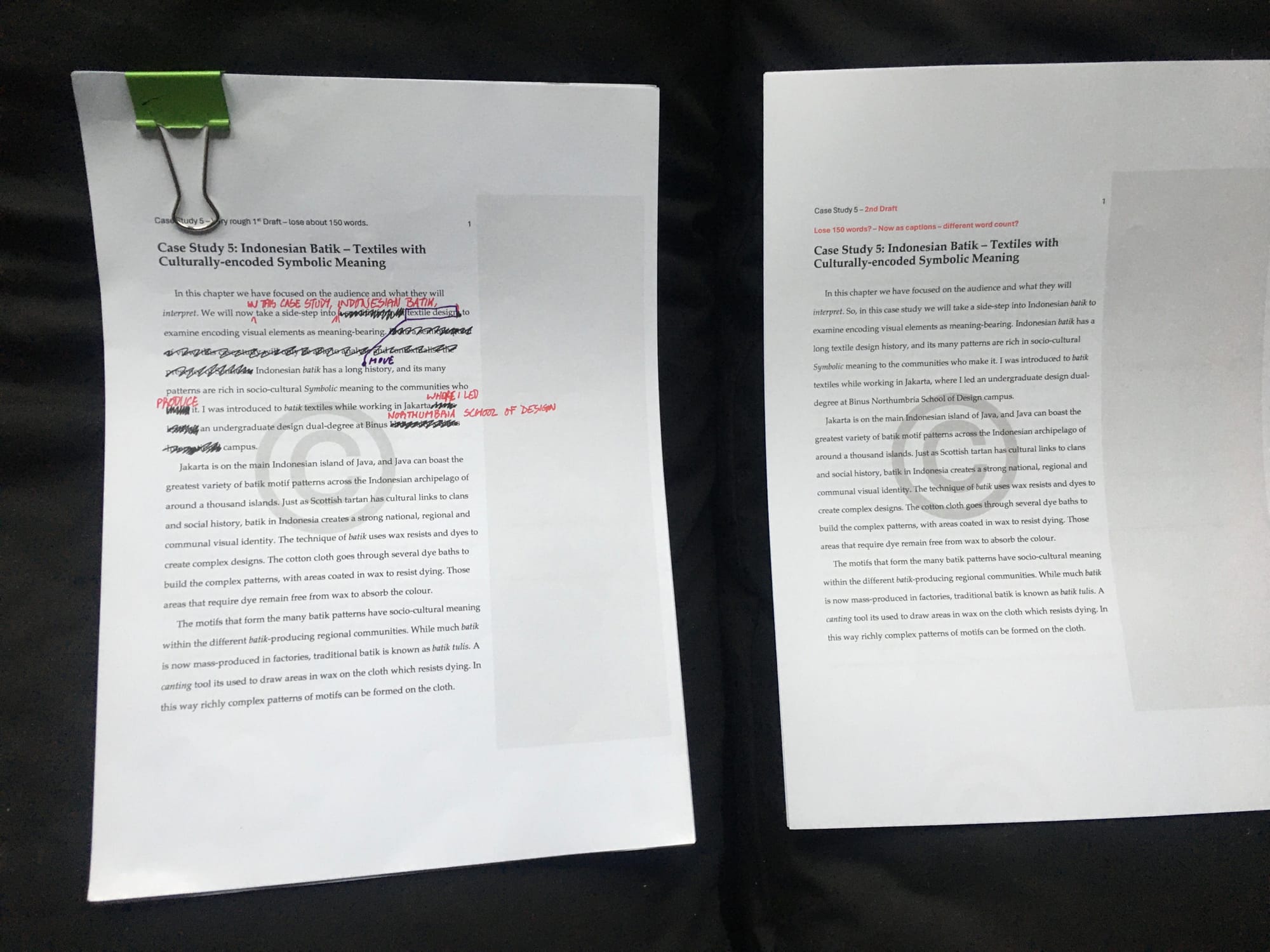
First raw and chaotic draft
Semiotics for Designers and Illustrators (2026)
My 2014 Bloomsbury book Interface Design: An Introduction to Visual Communication in UI Design utilised a case study in each chapter. While this chapter/case study model was contractually imposed on me as an author, I found it was a crucial approach to take. A creative readership needs to be inspired as to how other creative’s have applied the principles discussed in each chapter.
As such, even as far back as my premature 2017 book proposal to Bloomsbury, I had already decided that case studies would be key to contextualise Semiosis. As I had a 9 chapter structure in three thematic parts, my 9 case studies would be thematically linked to a chapter. However, they would also have the scope to expand on the discussion in lateral ways. My key concern in choosing key cases study content was that they would only ever discuss semiotic sign-action indirectly.
This was because, in most case studies, Charles Sanders Peirce’s pragmatic semiotic theory wasn’t directly apparent to creatives (but semiotics was certainly present even if the creative wasn’t aware it was). There is already too much conjecture posing as ‘truth-seeking’ in modern society. There are too many TV ‘documentary’ programmes using the ‘what if/might be’ conjecture to then jump to an ‘IF SO then this other thing could be true, therefore IT IS A TRUTH’ approach (yes, I’m talking about you Giorgio Tsoukalos et al.). So, as an academic I was mindful to avoid tenuous conjecture that tried to pass off any creative work as ACTUAL direct application of Semiosis. This would be dishonest and counter-productive. After all, if the creative had directly applied Peirce’s theory then I would have written a different book.
Four out of the nine case studies came direct from my own research. The 1st case study reviewed the attempts to date to apply Semiosis into creative practice, going as far back to the New Bauhaus. It also established the Little Creative in Theoryland ® metaphor.
The 3rd and 4th case studies contextualised pragmatic aesthetics, and how creatives already use phenomenological methods in design practice. I used the 9th case study to summarise what a semiotic visual communicator could be, using my own creative semiotic journey as a practitioner/academic.
The remaining 5 case studies were outward-looking to contemporary practice that was semiotic in nature, which I used to demonstrate how pragmatic sign-action is present in existing creative practice. One argument I make throughout the book is that designers and illustrators are already working semiotically. This observation is not conjecture but a reality on which my book situates itself.
The 5th case study is one I had been planning since 2017. I used to run a design degree in partnership with an Indonesian university in Jakarta. A graphic design colleague there was engaged in ongoing research into Indonesia’s batik textile production. As soon as I signed my contract I had secured the collaboration of Dr Vera Jenny (Jane) Basiroen to collaborate on the socio-cultural Symbolic power of batik’s motifs in Indonesian culture.
My 2nd case study partly established how archaeology and anthropology utilised Semiosis in exploring the material culture of societies past and present. This then segued into architecture’s application of pragmatic semiotic sign-action and ended with a case study on the research of another creative colleague based in Cyprus. I nearly became Samaneh Eshraghi Ivari’s PhD supervisor as she developed a Peircean semiotic toolbox to semiotically explore how meaning is constructed and sustained in the Holy Shrine of Imam Reza in Mashad, Iran. Her research methodology utilised the Peircean semiotician Torkild Thellefsen’s emotional significance-effect as part of a ‘semiotic toolbox.’
A wonderful part of my academic life leading design degrees is the relationships I build with design professionals. The remaining three case studies came from conversations I had with designers eager to give talks to my students. Eilidh Reid is a creative at London-based branding agency How&How. She was a DJCAD graduate from the graphic design degree I ran. Since graduation she had worked as an illustrator, then moved into animation before returning to branding design.
Eilidh has developed systems using all of her skillsets to enhance branding. Her systems strongly parallel pragmatic semiotic-sign action, so I decided to feature two How&How projects as the 6th and 7th case studies spanning parts two and three of the book. These two case studies gave me the space to make the case that applying Semiosis is an enhancement of existing creative practice.
The final case study (which appeared as the 8th in the book’s third part) featured the brand strategy work of Edinburgh-based Brand Insiders. Fiona Burnett, consultant at Brand Insiders, focused on how a brand strategy works. This case study ended chapter 8 where I had been discussing the application of Semiosis to visually communicate semiotically.
Fiona’s case study allowed me to illustrate how effective visual communication is a strategy, and Peirce’s pragmatic sign-action structures the visual mediation of connotative meaning to an audience. All of these practical-based case studies all demonstrated the target audience’s importance when visually communicating meaning.
Each of the nine 2000 word case studies featured images and diagrams to support the text. They were individually self-contained but each case study theme complemented the main chapters’ content. A big thank you to all the contributors who graciously gave there time to collaborating with me on these case studies.
If you want to be amongst the first to read my book in 2026 I will be posting some exclusive Bloomsbury discount codes in this newsletter nearer publication date.