006: My writing process… triadic communication
First raw and chaotic draft
Semiotics for Designers and Illustrators (2026)
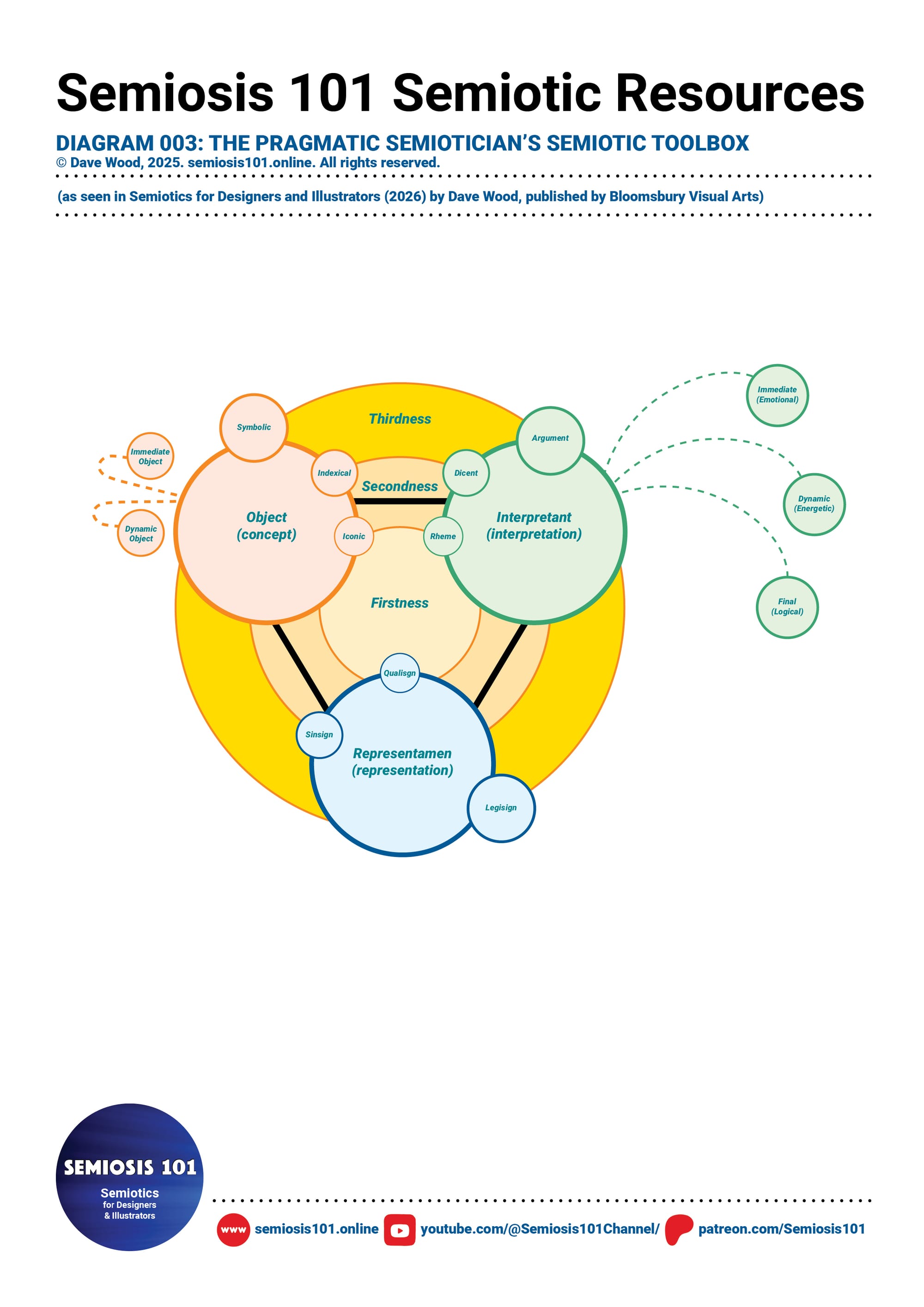
As you begin to understand Charles Sanders Peirce’s pragmatic semiotic theory you grasp that threes are important! His semiotic theory is predicated on triads - groupings of threes - and in the same vein I conceived my book in triads. The book is structured in three parts. Each part had three chapters. Each chapter had three components: the main text in plain language, a case study contextualising the application of Semiosis into practice, and the academic explanation of key points of his theory.
The reader’s education of Peirce’s semiotic sign-action was also triadically structured. The main plain language text was the main educational form, in turn supported by theory box outs, and captioned images or diagrams. While mirroring Peirce’s triadic thinking, my triadic structuring offers the reader a flexible way to learn about Semiosis.
As an educator I know there are different pedagogical learning styles. Some people are visual learners and others are not.
As my target readership was illustrators and designers, the visuals were crucial. But as my book’s subject is semiotics, each visual component in the book had to be proactive rather than passive ‘eye-candy.’ Each image, photograph or diagram was just as crucial as the main text in explaining how Semiosis worked, and why applying semiotic sign-action can enhance how designers and illustrators visually communicate.
The main text was written for creatives rather than semioticians, and although I wrote it in plain language, it did introduce Peirce’s obtuse terminology to the lay-reader. From my Semiotic Rosetta Stone research I translated his terms into a meta-language of creative-friendly terms aligned to tacit language illustrators and designers already understood. In many Semiosis 101 episodes (and in the book) I reassure academics and semioticians that this is not a dumbing-down of Peirce’s theory. It is a simple contextualisation of his theory into Visual Communication Design.
I have also consistently made the point that it is crucial for theory to be explained to creatives from within THEIR practice. I first fully made this point in a 2019 paper at the International Association of Societies of Design Research conference (IASDR) in Manchester. In my book I expand on this in a practically way with establishing my Little Creative in Theoryland® infographic strips. I argue that the two metaphorical worlds of Theoryland and Creativeland require a creative-focused interface. Theory written in the language of Theoryland is problematic to non-theoreticians. This is why my book is written from within Creativeland and my use of theory box outs throughout the book afford creatives entry points for further reading to Theoryland’s key theoreticians.
Hopefully you’ll agree that I have carefully considered all the educational learning styles when writing the book? Semiotics for Designers and Illustrators is a Creativeland book which interfaces well with Theoryland to improve ways for non-academics to access and apply theory.
If you want to be amongst the first to read my book in 2026 I will be posting some exclusive Bloomsbury discount codes in this newsletter nearer publication date.